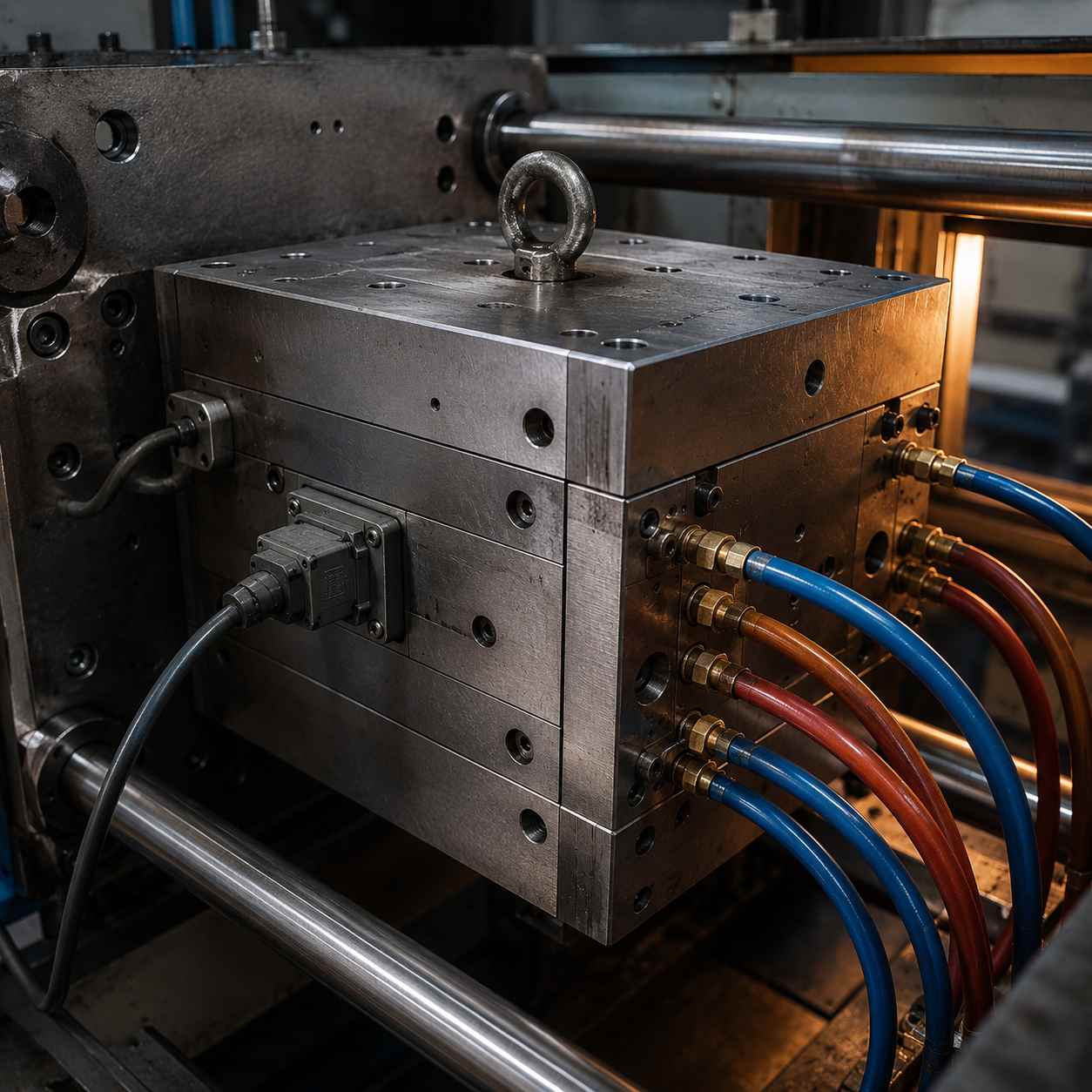
Customers often come to us not with a drawing of a future part, but with finished tooling: the mold has already been built and is sitting in a warehouse. It may have been inherited from a previous supplier, bought abroad, or ordered many years ago. The request sounds simple: set up molding on the customer's mold and start receiving parts without investing in new tooling.
In practice, several steps stand between "we have a mold" and "production is running": verify that the tooling is complete and sound, assess compatibility with the injection molding machine, adapt or repair the mold if needed, find a working process window, and approve a reference sample. Let's look at how this works at Promservice — from receiving the mold to serial production and storing the tooling between runs.
When molding on an existing mold comes up
This situation is typical for companies with an established product. The tooling was left over from a previous molder; the mold was bought abroad together with the technology; it was built long ago and has used up only part of its life; production is being moved to another site; the in-house molding shop was closed, but the parts are still needed. One thing is common to all of them: the money for the tooling has already been spent, and it makes sense to use up its remaining life rather than pay for a new mold.
Common reasons for changing molders
Production is not moved over trivialities. The most frequent motives:
- Shutdown of the previous production. The supplier closed, changed focus, or lost capacity.
- Part price. The cost per part is no longer acceptable.
- Quality and consistency. Drifting dimensions, flash, surface defects, scrap in the batch.
- Lead times. Missed delivery schedules and downtime on the assembly line.
- Logistics. Long shipping distances, customs, transport costs.
- Relocation and the wish to keep tooling in Ukraine. The mold is nearby and available at any time.
Incoming inspection: completeness and documentation
The first thing we do with a mold is receive it and carry out a condition survey. It starts with checking completeness: has everything needed for production actually arrived?
We look at the plates of the mold base, the cavity and core inserts, form pins and cores, ejector pins and the ejector plate, slides with wedges and locks, mounting hardware, keys, shipping straps and eye bolts, wrenches and special tools. We separately record spare inserts and cavity marking — without marking it is hard to trace which cavity produces a non-conforming part. The results of the survey are documented in a handover report describing the as-received condition: the mold remains the customer's property, we only perform work on it and are responsible for its safekeeping.
Condition of molding surfaces and the parting line
Next we assess what directly forms the part: wear of the molding surfaces and drift in dimensions, corrosion after storage without preservation, dents and nicks, the condition of the polish or texture. Damaged micro-relief is harder to restore than a polish. We separately check the parting line — contact and closing without flash, crushed edges, traces of "fitting" with a file. Then the guide pillars, bushings and locks for play and galling, the sprue bushing and locating ring: the condition of the spherical seat, the bore diameter, the fit. Traces of previous repairs — weld build-up, non-standard fasteners, holes "not per drawing" — are recorded separately: that is usually exactly where the mold fails next time.
Cooling, venting, and ejection
These systems are not directly visible on the part, but they determine cycle time, warpage, and stability. Cooling channels are checked for flow and leak tightness: we blow them through, pressure-test them if needed, and assess scaling, corrosion, and the condition of fittings and plugs. In molds that ran on untreated water, actual cooling often stopped matching the design long ago.
Vents are inspected for contamination — clogged venting produces burn marks and short shots. The ejection system is checked for full stroke and return to zero; we look for bent and worn ejector pins and assess the plates and springs. Moving units are cycled by hand to check smoothness of travel.
Hot runner: a separate check
If the mold has a hot runner, it calls for a more thorough inspection — this is where most of the surprises hide:
- system layout: manifold, number and type of nozzles, zone count;
- integrity of heaters and thermocouples — we measure resistance and check the circuits;
- presence of a controller, cables and connectors, correct wiring;
- condition of the nozzles and gate areas, residues of solidified material;
- condition of the wiring and insulation inside the mold;
- origin of the components: original units or non-original replacements.
If the controller did not arrive with the mold, that can be solved — but it needs to be known before the tooling goes onto the machine.
Compatibility with our machine fleet
A sound mold will not run if it does not fit the machine. So in parallel we check the compatibility of the tooling with the injection molding machine:
- clamping force against the projected area of the part and the runner system;
- minimum and maximum mold height, overall dimensions relative to the tie-bar spacing;
- moving platen stroke — whether the daylight is enough for part removal;
- shot capacity for the shot weight: the shot must fall within the usable screw stroke, otherwise melt residence time in the barrel goes up;
- clamping scheme: slots or threaded holes, their pitch and layout;
- locating ring diameter, nozzle spherical radius, and sprue bushing bore;
- cooling and ejection connections: fittings, circuits, knockout rods, threads, stroke;
- hot runner controller connectors and power rating.
The Promservice fleet is 22 injection molding machines from 50 to 650 tons (Arburg, Bole, Engel, Haitian). This lets us match a machine to most molds that come to us.
Adapting the mold to the machine
If a mold was designed for a different machine, it does not need to be rebuilt — adaptation is usually enough:
- adapter and intermediate plates — the standard solution for a mismatched clamping scheme;
- replacing the locating ring to match the machine platen bore;
- replacing or reworking the sprue bushing to match the nozzle spherical radius;
- cooling fittings and manifolds — bringing connections to a single standard;
- ejector knockout rods to match the thread and stroke of the specific machine;
- reworking the clamping — clamp plates, holes, brackets, only by agreement.
These are quick jobs for the toolroom, done in parallel with trial preparation. Worn molding surfaces, a damaged parting line, or a non-functional hot runner, however, mean a full repair, which is planned separately.
Repair and upgrades before startup
Based on the condition survey, we show what must be done and what is advisable:
- cleaning and flushing the cooling channels, replacing plugs and fittings;
- restoring the polish of the molding surfaces;
- repairing worn edges, fits, and the parting line;
- replacing ejector pins, guide pillars, and bushings;
- making replaceable inserts in high-wear areas;
- adding venting and improving cooling where they were insufficient.
Repair, upgrading, and maintenance of tooling is a separate line of work at Promservice, so the mold does not have to travel to yet another supplier.
Trial run and sample approval
The goal of trials is not simply "to get a part," but to find a working process window with margin, so that production does not run on the edge of scrap. We bring the mold to a stable setting, dial in the injection profile, holding pressure, cooling and ejection times, check cavity balance by shot weight, monitor critical dimensions and warpage, and record flash, short shots, burn marks, sink marks, and ejector pin marks.
The output of this stage is an agreed reference sample and acceptance criteria. If the trials reveal limitations of the mold itself, we demonstrate them clearly and offer options: reworking the tooling, changing the process settings, or adjusting the part requirements.
Serial molding on your mold
Once the sample is approved, the mold goes into production and repeatability becomes the priority. We ensure stable process settings, control of material drying, periodic measurement of critical dimensions and part weight, visual inspection of surfaces, packaging, and delivery on the customer's schedule. Processes run within a quality system certified to ISO 9001:2015. Volumes can vary — from small batches to regular output — and a fleet of 22 machines lets us schedule runs without long waits for equipment. In how the work is organized this is ordinary contract injection molding — the difference being that the tooling is already yours.
Tooling maintenance and storage
A mold that has been brought to stable operation needs care — otherwise a year later the whole story repeats itself.
- Preventive maintenance by cycle count. Cleaning, lubrication, and unit checks after an agreed number of cycles.
- Preservation after shutdown. Protecting molding surfaces and channels from corrosion.
- Storage at our site. The mold stays with us between runs and is ready to go onto a machine.
- Tooling history. We log cycle counts, repairs, and replaced components.
What the customer needs to provide
For a fast startup with no guesswork, it helps to receive from the customer:
- the mold itself, complete with all available accessories;
- drawings or 3D models of the mold and the part, if they still exist;
- the mold data sheet, cycle count records, previous process sheets and settings;
- a reference sample of the part or a previous batch;
- the material grade, colorant type, and color requirements;
- quality requirements, critical dimensions, volumes, and schedule.
If the documentation is missing, that is no reason to abandon the startup. We measure the mold and the part, carry out the condition survey, reconstruct the necessary data, and dial in the settings from scratch during trials. That scenario simply takes more preparation time.
Common surprises with molds that have been in service
Experience with receiving third-party tooling yields a fairly consistent list of issues:
- hidden wear — the mold looks intact, but part dimensions are already out of tolerance;
- clogged cooling channels — the cycle stretches out and the part warps;
- worn ejector pins — marks on the part, sticking, risk of damaging the steel;
- damaged texture, whose restoration requires separate work;
- non-original hot runner components — harder sourcing of spare parts;
- no spare inserts — any breakage stops production;
- a mold designed for a different material grade — different shrinkage, recalculation needed;
- a mold designed for a different machine type — mismatched clamping, solved by adaptation.
None of these situations is a dead end. What matters is spotting them at the incoming stage, not at the third thousand cycles.
How Promservice helps you get your mold running
We take on customer tooling as a complete project:
- perform incoming inspection and a condition survey documenting the as-received state;
- check compatibility with our fleet of 22 injection molding machines from 50 to 650 tons and select the machine;
- adapt the mold to the equipment: adapter plates, locating ring, sprue bushing, fittings, knockout rods;
- repair and upgrade the tooling in-house (CNC, EDM, grinding, polishing);
- manufacture replaceable inserts and ejector pins from Bohler, DME, Pro Plastica, Mold-Masters, and Incoe components;
- run trials and approve the reference sample;
- run serial molding with quality control, and maintain and store the mold between runs.
Need molding on your own mold?
If you have a finished mold and need to organize part production, Promservice will provide molding on the customer's mold — with incoming inspection, adaptation to the machine, repair where required, and a ramp-up to stable serial production in Ukraine.
Send photos and overall dimensions of the mold, part drawings or a 3D model, a reference sample, and details of the material and volumes — we will assess the condition of the tooling, select a machine for it, and propose a startup plan.