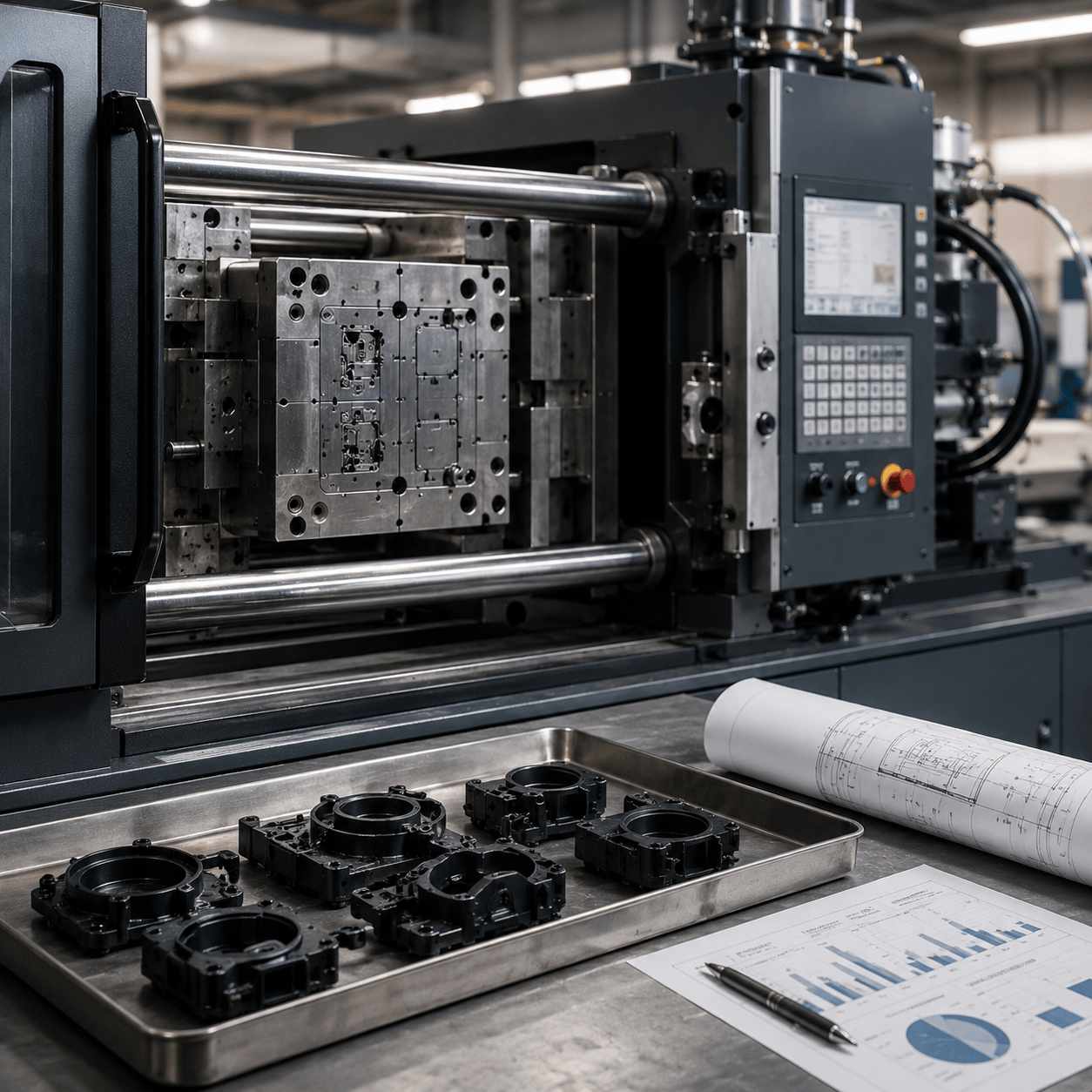
An injection mold is one of the most significant upfront investments in a plastic injection molding project. Before ordering tooling, it is important to understand more than its price: is the investment justified for the planned volume, when will it pay back, and what mold concept is appropriate for the part?
In stable series production, a mold can pay for itself many times over through a lower variable cost per part. In other cases, it is more sensible to start with 3D printing, CNC machining, or another process, validate demand, and return to tooling later.
This article explains when an injection mold is worth making, how to calculate the break-even point, and which factors besides production volume affect the decision. Promservice designs and manufactures injection molds in Ukraine and helps customers assess part manufacturability and the business case for tooling.
Why a mold is an investment, not just a cost
The mold is paid for at the start of the project, but with appropriate design, operation, and maintenance it can be used over an extended period. Its service life depends not only on mold materials, but also on the polymer, abrasive fillers, mold design, processing conditions, maintenance quality, and actual cycle count.
It is therefore more accurate to treat the mold as part of the upfront investment that is allocated across the planned production volume. The calculation should include not only mold manufacturing, but also related startup costs: design, mold trials and adjustment, and, where needed, auxiliary fixtures, purchased components, and part validation.
The economic logic is straightforward:
- upfront tooling costs are allocated across the entire production volume;
- as the number of parts grows, their tooling-cost share decreases;
- once the mold has paid back, the key drivers are the variable molding costs: material, machine time, labor or automation, energy, quality control, scrap, and logistics.
So the central question is not simply “How much does the mold cost?” but “At what output will the investment pay back, and which tooling option gives the best overall economics?”
The main factor — production volume
There is no single production volume at which an injection mold becomes profitable for every part. The decision depends on the part’s size and geometry, resin grade, tolerance and cosmetic requirements, molding cycle, mold complexity, cavity count, alternative manufacturing cost, and demand forecast.
These broad patterns can serve as an initial guide:
- One-off parts and tens of units. 3D printing, machining, or buying an off-the-shelf equivalent is often more economical. A mold may still be justified by material, accuracy, or repeatability requirements.
- Hundreds of units. Compare options using the total project cost. For relatively simple parts or where the alternative is expensive, simplified tooling may already be reasonable.
- Thousands and tens of thousands. Injection molding often becomes competitive, but the calculation still needs to include the mold cost, output rate, cycle time, and quality requirements.
- Large series. With stable demand, it is especially important to optimize throughput, cavity count, cooling, runner system, automation, and the mold maintenance plan.
Evaluate not only the first order but the total volume over the product life cycle. A part may be produced for years, while demand can grow or prove lower than forecast.
How to evaluate mold payback
Mold payback compares the upfront tooling investment with the savings per part versus an alternative manufacturing method.
A simplified break-even formula is:
Parts to break even = upfront tooling investment / (alternative unit cost − injection molding variable unit cost).
The upfront tooling investment typically includes mold manufacturing, design, mold trials, and adjustment. Variable molding cost should not be reduced to “material plus cycle time”: depending on the project, it may include machine time, labor or automation, energy, quality control, process scrap, packaging, and logistics.
A practical calculation sequence:
- Determine the full cost of the part without a mold — by 3D printing, CNC machining, purchasing an equivalent, or another method. Include post-processing, scrap, logistics, and minimum order quantities.
- Calculate the variable cost per part in injection molding — without allocating the mold cost.
- Find the saving per part — the difference between the alternative and molding.
- Divide the upfront tooling investment by that saving — this gives an estimated number of parts to break even.
- Compare several demand scenarios: minimum, realistic, and optimistic.
When molding’s variable unit cost is not lower than the alternative, the mold will not pay back through unit-price savings alone. It may still be necessary for technical, quality, or organizational reasons.
Not just volume: when a mold is needed even at low runs
A mold may be ordered for a modest run because the decision is driven by product requirements rather than direct unit-cost savings:
- Repeatability and controlled accuracy. With proper part, mold, and process design, injection molding can reproduce geometry consistently. Achievable tolerances depend on the polymer, shrinkage, design, and manufacturing conditions.
- Material requirements. Where a specific resin grade, filler content, required performance, or verifiable manufacturing process is needed, an alternative process may not deliver an equivalent result.
- Surface appearance. Molding can reproduce a defined mold polish or texture. The final surface depends on the resin, mold design, gate location, venting, and processing conditions.
- Assembly requirements. The part must mate consistently with other components and withstand the specified loads.
- Growth potential. When demand is expected to increase, tooling may be designed with appropriate allowance for service life or future modernization — after the business case has been validated.
In such cases, the decision is not based only on the price of one part. The critical question is whether another process can provide the required properties, quality, and repeatability.
Mold cavity count: how volume affects mold design
Production volume affects not only the “make a mold or not” decision, but also what kind of mold is needed:
- Single-cavity mold. Usually simpler and less expensive to manufacture. It can suit low and medium volumes, large parts, or parts with complex geometry.
- Multi-cavity mold. Produces several parts in one shot and can reduce unit cost at sufficient volume. It also increases upfront cost and requirements for runner balancing, cooling, maintenance, and injection molding machine capacity.
Cavity count should be selected using the full set of project parameters: planned volume and delivery schedule, cycle time, part size, material, target output, machine clamping force and shot capacity, and the budget available for tooling.
The wrong choice in either direction costs money. Excess cavity count with limited demand can mean unnecessary tooling expenditure, while too few cavities can constrain throughput and raise unit cost in a large series. Promservice selects the mold concept and cavity count for the project’s actual conditions.
Tooling types by budget and life
Injection mold design should match the task, expected volume, and chosen resin.
- Prototype, bridge, or low-volume tooling. This may use a simpler design and lower initial investment. The materials and expected life must be determined case by case, including the effect of the resin, abrasive fillers, surface requirements, and planned cycle count.
- Production tooling. This is designed for maintainability, process stability, cooling performance, replaceable inserts, and service. Steel grades, heat treatment, and coatings are selected for the operating conditions, not only the projected quantity.
A phased strategy is sometimes sensible: first validate the product design and demand using a simpler solution, then invest in a full production mold. However, the decision should account for whether the first tool can still be used later and whether duplicated work would create unnecessary cost.
Common mistakes in the tooling decision
In practice, the main risk is not the mold price itself, but poor input data or a calculation that considers only one factor:
- Over-investing at the start. Ordering a complex multi-cavity mold for demand that has not been validated.
- Underestimating future volume. Choosing a solution without sufficient service life or maintenance capability for a product that later enters a large series.
- Assessing only the first order. Ignoring total output, repeat orders, and seasonality.
- Comparing incomplete costs. Excluding mold trials, adjustment, scrap, maintenance, logistics, or post-processing from the calculation.
- Ignoring part manufacturability. Failing to review draft angles, wall thicknesses, undercuts, shrinkage, cosmetic requirements, and part ejection before mold manufacturing starts.
The right decision is based on a realistic forecast, a manufacturability review, and a comparison of several economic scenarios — not simply on the desire to spend less now or choose the most complex option “for the future.”
How Promservice helps you decide
Promservice treats tooling as part of the whole project’s technology and economics. We can:
- assess part design, material, and planned volume;
- identify key technical risks before mold manufacturing starts;
- prepare an initial payback estimate against alternative methods;
- recommend cavity count, runner-system type, and an appropriate level of mold complexity;
- propose a phased launch strategy where it is economically justified;
- design and manufacture the injection mold in-house;
- perform mold trials and provide tooling service, repair, and modernization;
- manufacture serial plastic parts on our own injection molding machines after the mold has been manufactured and fine-tuned.
Our goal is to propose a technically justified solution that matches actual demand, part-quality requirements, and project economics.
Need a mold and injection-molding cost estimate?
Send us a drawing or 3D model, information about the material, part requirements, and expected production volume. Promservice specialists will assess the part’s manufacturability, help select the mold design and cavity count, and prepare the initial data needed to evaluate the tooling payback.
We provide a complete production cycle: mold design and manufacturing, mold trials and fine-tuning, as well as serial production of plastic parts on our own injection molding machines.