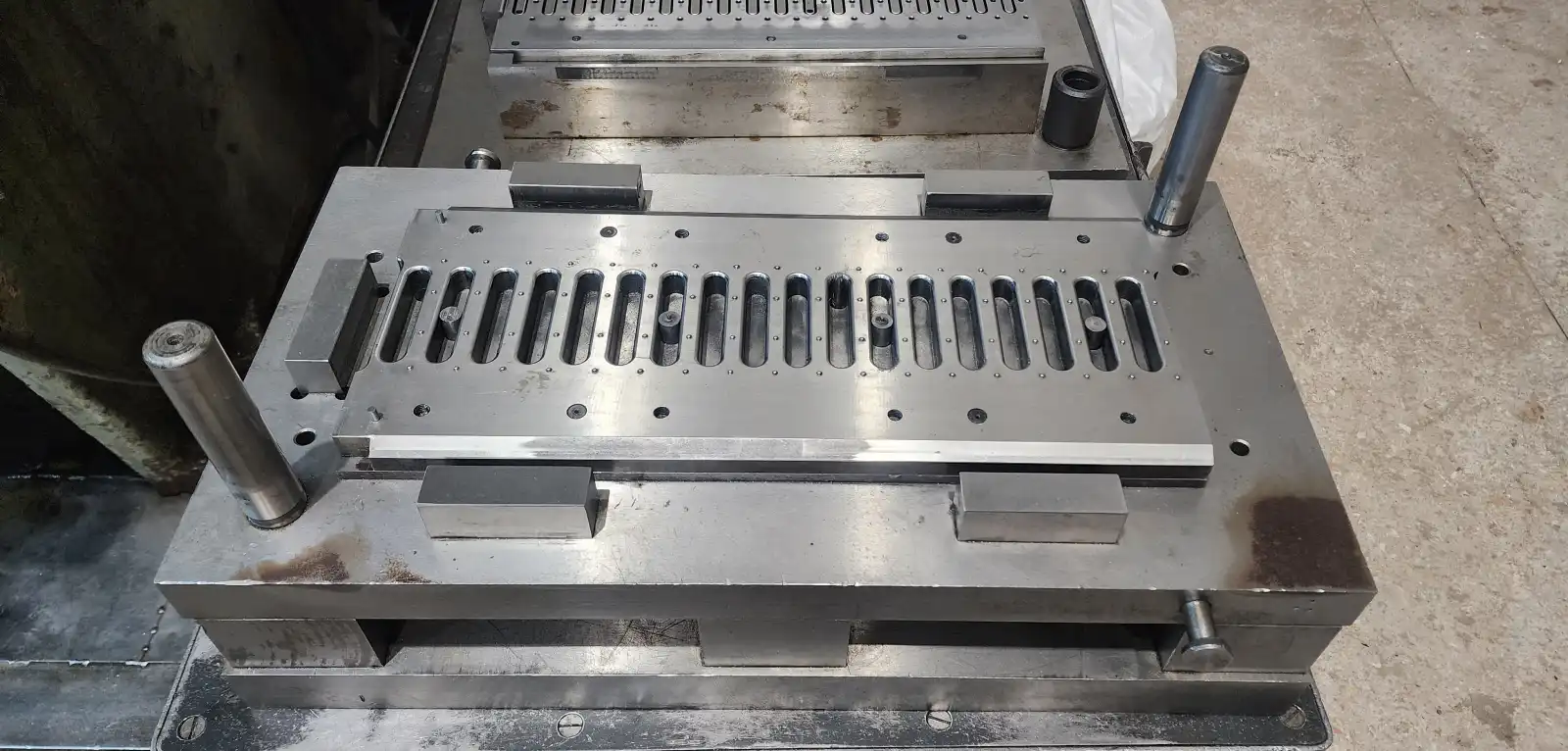
When a business needs thousands (or millions) of identical parts, the key factors are predictable quality, fast cycle times, and a low unit cost. That is why sheet metal stamping remains one of the most popular technologies for mass production. With the correct die design and stable process control, stamping produces parts that meet tight tolerances and are easy to assemble.
Promservice manufactures stamping dies, produces stamped parts to order, and provides tooling maintenance and repair across Ukraine. We support customers throughout the full lifecycle — from design and manufacturing to process tuning and refurbishment of dies and punches.
What is sheet metal stamping?
Sheet metal stamping is a metal forming process where a press and a die set transform sheet material into a finished part. Depending on the task, the operation can be performed in one step or in a sequence of stages (for example, in progressive dies). Stamping is widely used for:
- brackets, clips, and mounting elements;
- housings, covers, panels, and enclosures;
- automotive and agricultural components;
- electrical and HVAC parts;
- general industrial serial products.
Key advantages for mass production
Sheet stamping is valued for a combination of productivity and repeatability. For high-volume manufacturing, it offers several practical benefits:
- High output and fast cycle time. A press can produce parts in seconds, and progressive dies can perform multiple operations in a single stroke.
- Stable geometry and repeatability. Properly designed tooling ensures consistent dimensions from part to part, which reduces assembly issues and rework.
- Low unit cost at scale. Tooling requires an initial investment, but in serial production the cost per part drops significantly.
- Efficient use of material. Optimized nesting and precise blanking help reduce scrap and improve raw material utilization.
- Compatibility with automation. Feeding systems, coil lines, and robotic handling make stamping ideal for automated production lines.
- Wide range of materials. Stamping can be used with carbon steel, stainless steel, aluminum, and other sheet materials (depending on thickness and requirements).
Common stamping operations
In real production, stamping is rarely “just one operation.” Most parts require a combination of forming steps, such as:
- Blanking – cutting the outer contour of a part;
- Punching – creating holes, windows, or slots;
- Bending – forming flanges and angles for rigidity and assembly;
- Deep drawing – producing cups, shells, and volumetric shapes;
- Coining / embossing – adding stiffeners, markings, and functional reliefs.
Promservice selects the optimal operation sequence and die type for your part — from simple single-operation tooling to multi-stage and progressive stamping dies.
Tooling is the core of quality
In stamping, the die determines the result. Even a powerful press cannot compensate for worn cutting edges, incorrect clearances, or misalignment. That is why industrial customers focus on:
- proper die design (geometry, clearances, wear zones);
- hardened tool steels and correct heat treatment;
- reliable guidance and alignment;
- quick-change solutions and interchangeable inserts for wear areas.
Promservice designs and manufactures stamping dies with maintainability in mind, and we also provide repair and modernization when the tooling is already in service.
Process stability and quality control
Mass production only works when the process is stable. In stamping, quality is typically ensured through:
- incoming inspection of sheet material (thickness, surface, coating);
- control of tool condition (cutting edges, guides, springs);
- measurement of critical dimensions and tolerances;
- burr and edge quality control after cutting;
- trial runs and adjustment of press settings.
If required, we help customers improve the process by tuning the die, upgrading wear components, or revising the operation sequence to reduce rejects.
When stamping is the best choice
Sheet metal stamping is especially effective when you need:
- large batches with the same geometry;
- consistent quality for assembly lines;
- short cycle times and predictable schedules;
- parts with holes, bends, and repeatable features;
- a scalable process ready for automation.
If your product is moving from prototyping to serial production, stamping can be the next step to lower unit cost and increase output.
Need sheet metal stamping in Ukraine?
Promservice offers metal stamping services, manufacturing of stamping dies, and production of stamped parts to order. Contact us — we will review your drawings, propose the optimal technology, and ensure reliable mass production with stable quality.