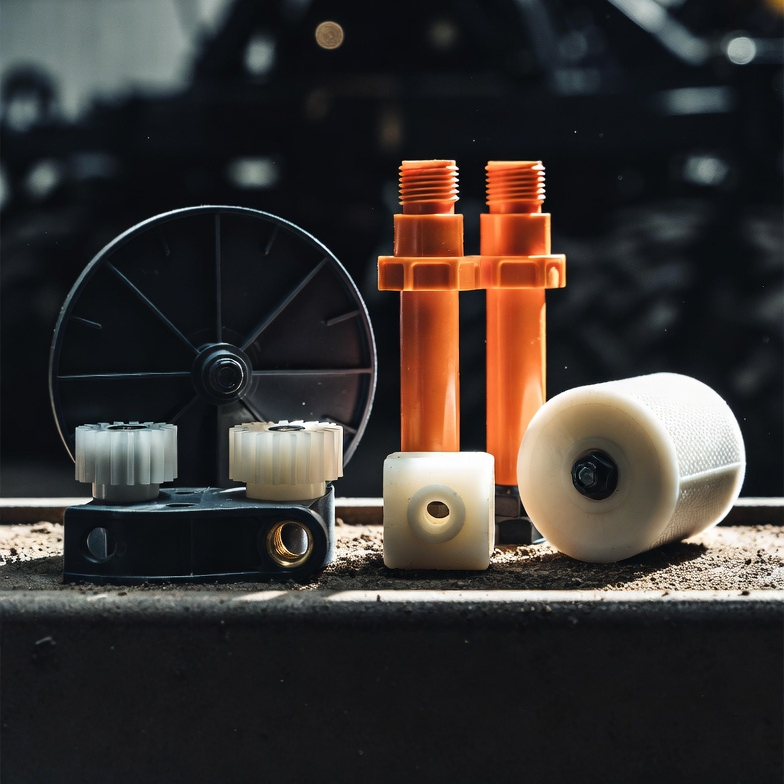
Agriculture is one of Ukraine's largest consumers of machinery, and the fleet in the field is mixed: imported tractors, combines, seed drills, and sprayers work alongside domestically built equipment and models long out of production. Almost every one of these machines has polymer components that fail sooner than metal ones. That makes plastic parts for agricultural machinery a constant need rather than a one-off: some parts are worn away by abrasives, some crack in the cold, some are destroyed by ultraviolet within a couple of seasons.
The problem is that the original spare part is often disproportionately expensive, slow to arrive through the supply chain, or discontinued altogether. Hence the steady demand for local production of polymer parts by injection molding and for localized sourcing at Ukrainian machinery manufacturers. In this article we cover the operating conditions of agricultural parts, material selection, reproducing a part from a sample, and the economics of tooling. Promservice builds molds and molds plastics on its own fleet of injection molding machines, so it can carry a project from sample to production run.
Two typical customer scenarios
Requests for agricultural parts come from two different directions, and they follow different logic.
- Agricultural machinery manufacturer. Serial parts are needed for their own machine: housings, brackets, hopper components, trim. Here what matters is consistent batch quality, dimensional repeatability for the assembly line, and localization — replacing imported components with Ukrainian ones so production no longer depends on delivery lead times.
- Service shop, dealer, or spare-parts distributor. A specific part must be reproduced to replace an unavailable original: there is a worn or broken sample, there is an understanding of the assembly, but there is no supply. Here the priorities are accurate reproduction of the fits and a sensible batch size.
Both scenarios are covered by the same technology chain: model — tooling — molding. The only difference is where the initial geometry comes from.
Operating conditions: why agricultural parts are tougher than "ordinary" ones
A part working in the field has a harder life than an equivalent part indoors or in a passenger car. Designing it "like an ordinary part" is a classic mistake.
- Ultraviolet and full daylight. Machinery works in open sun, and the polymer takes the maximum UV dose throughout the season.
- Wide temperature range. Roughly from -30 °C in winter in an open yard to +60 °C and above on a sun-heated surface.
- Vibration and impact loads. Constant shaking over rough ground, stone strikes, snagging on soil and crop residue.
- Abrasion. Dust, soil, sand, grain, straw — all of it continuously wears the working surfaces.
- Chemicals. Contact with fertilizers, crop protection products, fuel, oils, hydraulic fluid.
- Pressure washing. High-pressure water and aggressive detergents after every shift or season.
- Seasonality and storage. A few weeks of intensive work, then a long idle period — often outdoors, with moisture, condensation, and temperature swings.
Typical plastic parts on agricultural machinery
The range of polymer components in farm equipment is wide, and most of them are well suited to injection molding.
- Seed metering units. Seed discs, rollers, housings, deflectors, scrapers — the most precise and most critical group.
- Metering and distribution systems. Fertilizer spreader components: metering units, gates, distribution discs and vanes.
- Sprayer components. Nozzle bodies, spray tips, filters, caps, manifold elements.
- Containers and guides. Hoppers, funnels, trays, chutes, guides for seed and fertilizer.
- Conveying components. Auger parts, elevators, conveyors, scrapers and wear pads.
- Drive and support elements. Gears, sprockets, bushings, plain bearings.
- Brackets, holders, protective covers and shields. Often with metal inserts.
- Cab and body panel parts. Panels, covers, vent grilles, armrests, trim pieces.
- Hatch and filler caps. Fuel, oil, hopper — with sealing and threads.
- Lighting and electrical parts. Lamp housings, lenses, boxes, harness holders.
- Header components. Fingers, liners, guides, hold-down strips.
- Lubrication and hydraulic system parts. Holders, covers, line protection elements.
Materials for agricultural applications
Choosing a polymer for farm machinery is always a compromise between mechanics, chemical resistance, and weather. The general selection logic is as follows.
- PA6 and PA66, including glass-filled PA-GF. Loaded and wear-resistant components: gears, brackets, bushings, structural housings. They offer high strength and stiffness. Moisture absorption of polyamides must be accounted for — once saturated, the part changes dimensions and mechanical properties, and this is designed into the fits.
- POM (acetal). Precise moving elements with low friction and stable dimensions: seed metering units, metering devices, adjustment mechanisms.
- PP, including talc-filled and UV-stabilized grades. Housings and container parts, good resistance to fertilizers and working solutions, moderate cost.
- HDPE. Tanks, trays, hopper liners, wear-resistant sliding pads and guides.
- ABS and ASA. External trim parts. For machinery permanently in the sun, ASA is substantially better than ABS in UV resistance: it yellows and chalks far more slowly.
- PC/ABS. Impact-resistant housings and panels where a combination of stiffness and toughness is needed.
- PU and elastomers. Sealing and damping elements, protective bellows, shock-absorbing pads.
- Fluoropolymers. Components in contact with aggressive chemicals, where chemical inertness and low friction are critical.
UV stabilization and colorant selection
For agricultural parts, UV protection is not an option but a baseline requirement. Unstabilized polyolefin or ABS in open sun loses impact toughness within one or two seasons, fades, develops micro-cracks, and starts crumbling at the edges.
That is why UV stabilizers are built into the formulation and the colorant is chosen correctly. Carbon black (black pigment) acts as an effective UV barrier and in practice delivers the best durability — which is exactly why most technical agricultural parts are black. Colored and light-toned parts are also possible, but they require a specially selected stabilized compound, and this should be agreed before the tooling is built.
Key engineering requirements
Beyond the material, there is a set of requirements that determine whether a part will actually work in the field.
- Geometric accuracy of seed metering and dosing elements. Cell dimensions, clearances, and alignment directly affect seeding rate and distribution uniformity — tolerances here are tight, and a worn original cannot serve as an "as-is" reference.
- Wear resistance. Abrasion in the contact zone with seed, fertilizer, and soil determines part life more than nominal strength does.
- Impact resistance in the cold. Many polymers lose toughness sharply at sub-zero temperatures — a part that flexes in summer chips off in winter.
- Dimensional stability under moisture. For polyamides this is critical: fits and clearances are calculated with swelling in mind.
- Resistance to stress cracking. The combined action of mechanical stress and chemicals (fertilizers, solvents, detergents) produces ESC cracks even where each factor alone is harmless.
Reproducing a part from a sample: reverse engineering
If the original spare part is unavailable and all you have is the part itself — worn, cracked, or broken — the task is solved by reproducing the geometry. The sequence is usually as follows.
- Sample analysis. We assess the nature of the wear and failure and determine which surfaces are functional and critical and which are worn and cannot serve as a reference.
- Measurement and 3D scanning. Precision measuring equipment for functional dimensions, scanning for complex surfaces and overall shape.
- Rebuilding the 3D model and drawing. The geometry is built "as it should be," compensating for wear and material shrinkage.
- Agreeing on critical dimensions and fits. With the customer we fix exactly what must match the mating parts of the assembly: axes, threads, mounting points, clearances.
- Identifying the material. From markings on the part if they survived, from the character of the fracture, and from the real operating conditions of the assembly.
- Tooling and production. Mold design and manufacture, trial runs, fitting the part in the assembly, serial molding.
What can be improved compared to the original
Reproducing from a sample does not mean copying the flaws along with the part. If a part consistently breaks in the same place, that is a design problem, and it makes sense to eliminate it when new tooling is built.
Typical improvements: reinforcing problem areas with ribs or local thickening, increasing radii at stress concentration points, evening out wall thickness, correcting draft angles, switching to a stronger or more cold-resistant material, adding glass fiber reinforcement. Such changes are agreed in advance — the key point is that the part remains interchangeable with the original in terms of its mating dimensions.
Inserts: metal inside a plastic part
Many agricultural parts cannot be made purely from plastic. Brackets, levers, holders, and loaded housings require metal bushings, threaded inserts, shafts, or reinforcing elements that are encapsulated directly during molding.
This gives an accurate and immovable seating of metal in polymer with no subsequent assembly or press-fitting, which is especially valuable for components exposed to vibration. Insert molding has its own requirements for tooling and insert preparation, but in agricultural machine building it is everyday work.
Volumes, seasonality, and tooling selection
Agricultural machinery rarely calls for million-unit runs of a single part. The typical picture is medium and small batches, a wide product range, and pronounced seasonality: demand peaks during sowing or harvest, and for the rest of the year the part is barely needed.
That is why tooling is matched to the actual volume rather than built "for growth." For small batches, a simplified single-cavity mold with minimal automation makes more sense; for stable serial items, a multi-cavity mold with a well-designed runner system and cooling. The main thing is not to pay for tooling whose life will never be used up. The basic principle is simple: the type of tooling must match annual demand, not the maximum possible output. Hard numbers for a specific volume come from the mold payback calculation.
Localized production: what it delivers in practice
For both machinery manufacturers and service shops, local production of polymer parts means above all control.
- Shorter lead times: the part is made in Ukraine, with no international logistics or customs delays.
- Independence from imports: exchange rate swings, a queue at the supplier's plant, or a discontinued item no longer halt machinery production.
- The ability to quickly reorder a batch in season, when the part is needed "yesterday."
- Storage of the mold on the production site and fast restart with no repeat tooling cost.
- On-site quality control: samples, fitting in the assembly, adjustments — with no cross-border correspondence.
Not only molding: related capabilities for agricultural machine building
An assembly often consists of more than one plastic element, and it is more convenient to cover it entirely with a single supplier. Besides injection molding, Promservice performs CNC machining (milling, turning, grinding, EDM), sheet metal stamping and die manufacturing, welding, MIM for small metal parts of complex shape, compression molding of rubber and thermoset products (seals, handles, pads), and manufacturing of electrical equipment.
This means the customer can receive not plastic from one contractor and metal from another, but a coordinated set of assembly parts with a single point of responsibility.
How Promservice helps agricultural machinery manufacturers and service shops
Production operates under the ISO 9001:2015 quality system and has its own tool room alongside the molding shop. For agricultural projects we can:
- analyze a sample, drawing, or 3D model of the part and assess its manufacturability for molding;
- rebuild the geometry from a worn or broken sample — measurement, 3D scanning, model and drawing;
- select a material for the specific operating conditions: loads, abrasion, chemicals, UV, frost;
- design and build a mold for the real volume — with a sensible number of cavities and the appropriate runner system type;
- produce parts on our own fleet of injection molding machines: 22 machines from 50 to 650 tons of clamping force, from trial samples to production runs;
- perform insert molding with metal inserts and related work — machining, stamping, welding, rubber compression molding;
- take the tooling into storage, servicing, repair, and upgrade so the item can be restarted quickly in season.
Need plastic parts for agricultural machinery?
If you need plastic parts for agricultural machinery — serial parts for your own machine or reproductions replacing an unavailable original — contact Promservice. Send a 3D model, a drawing, or simply a sample of the part, even a worn or broken one.
We will assess the task, propose a material and design improvements, size the tooling to your real volume, and provide stable production with predictable quality.