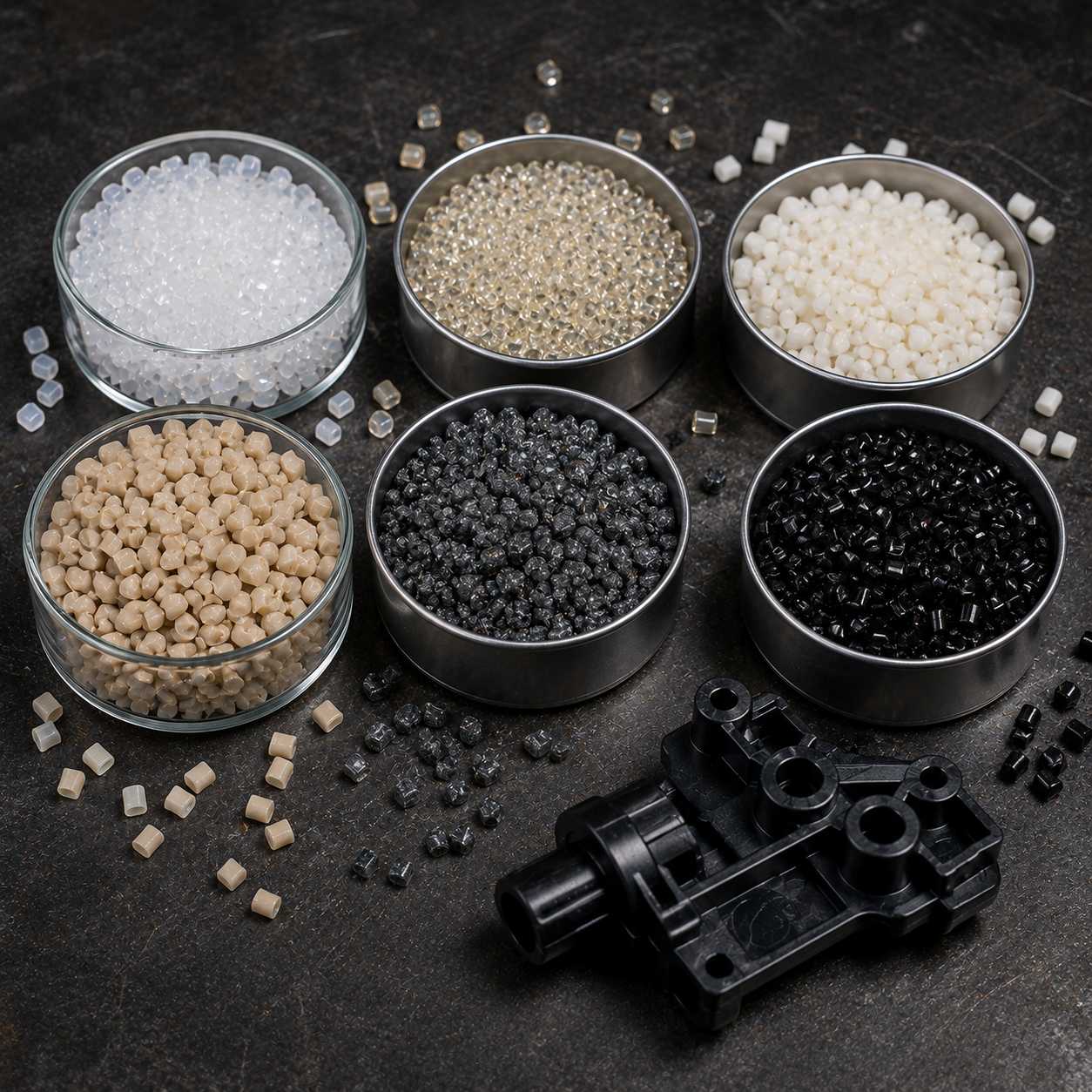
Polymer choice is one of the most important decisions in producing a plastic part. It determines not only material cost but also the ability to meet requirements for strength, heat resistance, chemical resistance, and appearance. A poor material choice often becomes the root cause of defects, expensive tooling rework, or field failures.
Promservice helps customers select the right material at the part and mold design stage. Below is a practical guide to the main plastics used in injection molding on IMM: where they fit, what to watch for during processing, what to consider when choosing, and how the choice affects the mold.
How to approach material selection
Before settling on a specific polymer, it helps to lock down several part parameters:
- service conditions — temperature, loads, chemical contact, UV, humidity;
- strength and stiffness requirements — static, dynamic, impact;
- dimensional accuracy and long-term stability — critical tolerances, stability over time;
- appearance — gloss, matte, color, texture;
- cost constraints — volume, target unit cost;
- regulations and certifications — food contact, medical, electrical;
- assembly technology — screws, snap-fits, adhesives, ultrasonic welding, insert molding.
This short checklist narrows the list of materials and lets you brief the process engineer with specifics — not "we need a strong plastic" but "the part operates at 90 °C, sees periodic impact, in a humid environment, with a 4 N·m threaded insert."
ABS — versatile engineering plastic
ABS (acrylonitrile-butadiene-styrene) is one of the most popular plastics for housings. It delivers good stiffness, impact resistance, and a quality surface out of the mold.
Typical applications: instrument housings, appliances, electrical products, toys, tool housings, decorative parts.
Processing: easy to mold, moderate shrinkage (around 0.4–0.7%), no extreme temperature demands. Sensitive to moisture — drying is recommended. ABS does not tolerate aromatic solvents well and has limited UV resistance (use stabilized grades for outdoor use).
PP (polypropylene) — high-volume material with chemical resistance
PP is a lightweight, low-cost, chemically resistant plastic. It is often used where low cost, chemical resistance, and adequate strength are needed.
Typical applications: packaging, technical and housing parts, containers, household items, medical consumables, caps, "living hinges."
Processing: high shrinkage (1.2–2.5%) — important to design into the mold. Wide process window, fills thin walls easily. Resistant to most acids, alkalis, and solvents. Lower stiffness than ABS — compensated by ribs and geometry.
PA (polyamide / nylon) — strong engineering plastic
PA6, PA66, PA12 are common engineering polyamides. They deliver high strength, wear resistance, and resistance to fuels and oils. Widely used in mechanically loaded assemblies.
Typical applications: gears, bushings, housings, brackets, fasteners, under-hood automotive parts, tool housings, technical assemblies.
Processing: highly hygroscopic — drying is mandatory, otherwise the part will show silver streaks, blisters, and reduced strength. Higher melt temperatures and tight process control are required. Shrinkage depends on filler (without filler — significant and anisotropic). Polyamides are often used with glass fiber — this increases stiffness and reduces shrinkage.
PC (polycarbonate) — transparency and impact strength
PC is a transparent plastic with exceptional impact resistance. It holds its shape at elevated temperatures and serves well as a glass substitute where strength matters.
Typical applications: transparent housings, protective screens, lighting diffusers, optical elements, power tool housings, medical parts, technical "glazings."
Processing: high melt temperature (above most commodity plastics), strict drying requirements. Sensitive to notches (stress concentrators), incompatible with some solvents and aggressive chemicals. For improved resistance, PC/ABS blends are used.
POM (polyoxymethylene, acetal) — stiffness and low friction
POM (Delrin, Polyacetal) is an engineering plastic with high stiffness, low friction, and excellent dimensional stability. It absorbs very little moisture.
Typical applications: gears, couplings, latches, moving assemblies, sliding parts, precision mechanical components, threaded fasteners.
Processing: relatively narrow process window — temperature must be tightly controlled (overheating degrades the polymer and releases gases). Shrinkage is noticeable (around 1.5–2.5%) and often anisotropic. Does not share runners with ABS or PVC. Long-term dimensional stability is a major advantage for precision parts.
PE (polyethylene) — flexibility and chemical resistance
HDPE (high density) and LDPE (low density) are commodity plastics with different levels of stiffness and flexibility. Chemically resistant, cheap, easy to process.
Typical applications: containers, vessels, technical housings, caps, packaging, household items, flexible parts.
Processing: high shrinkage, low heat resistance, limited stiffness. On the upside — wide process window and excellent flow. Often used where high mechanical properties are not required.
Engineering and specialty plastics: PEEK, PEI, PSU, PPS
For high-temperature, medical, aerospace, or specialty industrial applications, high-performance engineering plastics are used:
- PEEK — top tier, operates at 250 °C and above, chemically resistant, expensive;
- PEI (Ultem) — high heat and strength;
- PSU/PPSU — stable under sterilization, medical equipment;
- PPS — chemical and heat resistance.
These materials require high barrel temperatures, specialized tooling, and processing experience. They are used where commodity plastics cannot deliver.
Filled compounds: glass fiber, mineral, additives
To increase stiffness, strength, and dimensional stability, filled compounds are widely used:
- glass fiber (GF) — raises modulus, reduces shrinkage, adds stability; parts become stiffer but more brittle;
- mineral fillers (talc, chalk) — a cheaper way to increase stiffness;
- carbon fiber (CF) — for high mechanical performance;
- flame retardants, antistatic agents, colorants, UV stabilizers — functional additives for specific needs.
Filled compounds require more careful mold design: injection points, runner system, life of wear zones. Glass fiber wears channels and mold surfaces faster — this must be planned for (hardened steels, replaceable inserts).
How material choice affects mold design
The plastic choice has a major impact on tooling:
- Material shrinkage defines the working cavity dimensions. An error here means an undersized or oversized part.
- Processing temperature drives requirements for steel, cooling, and thermal balance.
- Chemistry and degradation influence steel selection (for PVC and flame-retardant grades — corrosion-resistant steels).
- Viscosity and flow define runner geometry, number, and location of injection points.
- Abrasiveness (especially with filled compounds) determines the need for hardened wear zones.
- Hygroscopicity drives process discipline and material drying requirements.
Choosing a material is therefore not just picking a polymer — it is coordinating it with the part and mold design.
Shrinkage: why it is critical to account for
Every polymer shrinks as it cools. If shrinkage is not accounted for at the mold design stage, parts will come out undersized or out of tolerance.
Approximate shrinkage ranges:
- ABS — 0.4–0.7%;
- PC — 0.5–0.7%;
- PP — 1.2–2.5%;
- PE — 1.5–3%;
- PA (unfilled) — 1.0–2.0%, with 30% glass fiber — 0.3–0.8%;
- POM — 1.5–2.5%;
- PA + GF — much lower but anisotropic.
Fillers (especially glass fiber) make shrinkage anisotropic — different along and across the flow direction. This affects warpage, dimensional accuracy, and assembly behavior.
How to select a material: a typical algorithm
In practice, the material selection sequence is usually:
- Define functional requirements — loads, temperature, chemistry, appearance, regulations.
- Shortlist 2–3 materials that theoretically fit.
- Check market availability — specific grades, suppliers, price, lead times.
- Assess manufacturability — molding, cycle, defect risks, mold requirements.
- Validate with a prototype or trial batch — for critical parts.
- Lock down grade and supplier in the specification — to avoid surprises in serial production.
Promservice supports all of these steps — from recommendations to trial runs — taking into account the specifics of the actual part and mold.
How Promservice helps with material selection
At the mold design stage, Promservice engineers treat the material as a key parameter:
- advise on part manufacturability for the chosen polymer;
- assess risks (shrinkage, warpage, weld lines, defects);
- design the mold to suit the material;
- select steel and surface hardness for abrasive or corrosive grades;
- help with supplier and grade selection.
In serial production, we secure process stability, drying, batch control, and quality repeatability.
Need help choosing a plastic for injection molding?
Promservice designs and manufactures injection molds, performs plastic injection molding on IMM, and helps select materials for your part. Send drawings or samples — we will evaluate the requirements, recommend the optimal polymer, and deliver stable serial production.