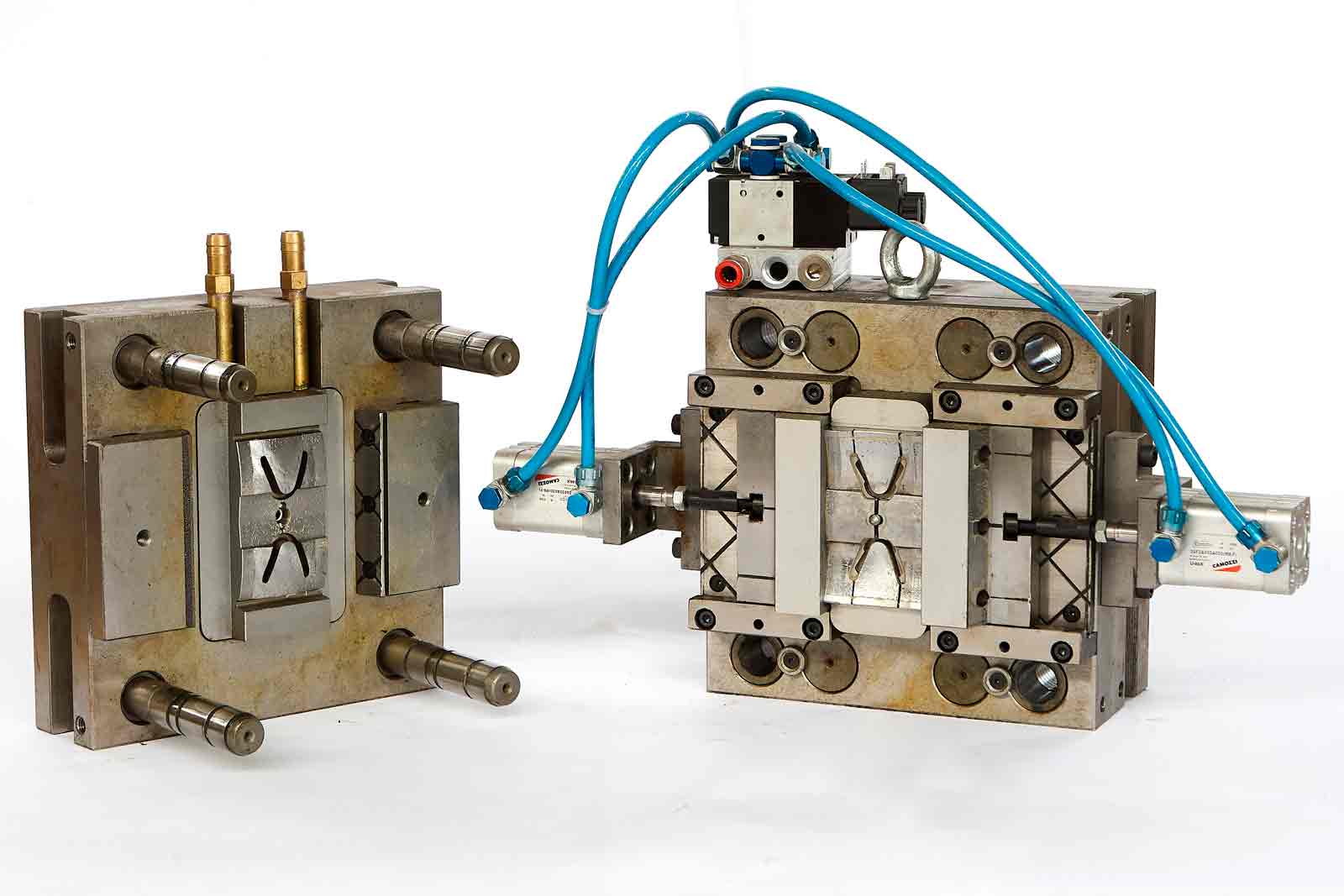
Mold manufacturing is not just a technical operation but a collaborative project between the customer and the manufacturer. And the first decision in that project is neither the material nor the part geometry, but the planned production volume: it drives the number of cavities, the runner system type, the steel grade and the service life of the tooling.
Production volume drives the mold design
The higher the batch size, the greater the requirements for automation, the number of cavities, and the mold's service life.
| Parameter | Prototypes / Small Series | Medium-Scale Production | Mass Production |
|---|---|---|---|
| Number of Cavities | 1 | 2–4 | 4–8 or more |
| Ejection | Manual | Semi-automatic | Fully automatic |
| Mold Material | Pre-hardened steel | Böhler (Austria) | Böhler (Austria) |
| Gating System | Cold | Cold / Hot | Hot runner (Mold Masters, Incoe) |
| Service Life | Up to 10,000 cycles | Up to 300,000 | 500,000 – 1 million+ |
| Compatibility with IMM | Up to 50 t | 50–150 t | 150–350 t and above |
| Cost | Low | Medium | High |
Getting it wrong in either direction costs money: a mold sized for a volume that does not exist yet takes years to pay off, while cheap tooling for a large series ends in repairs and downtime.
What to attach to your inquiry
The minimum for a preliminary estimate is a 3D model in STEP format, a drawing with critical dimensions, the material grade and the annual volume. If there is no model and no drawings, a sample will do: we take measurements, scan it in 3D where needed, and develop the documentation.
The full list of input data — material and color, tooling status, inserts, secondary operations, inspection and packaging requirements — is gathered in the checklist of data for a molding inquiry.
Let's Move Forward
Contact our team to discuss your project and get expert feedback. We'll help you assess technical feasibility, suggest the optimal manufacturing approach, and provide a clear quotation.
Start your project with confidence — get in touch with us today!