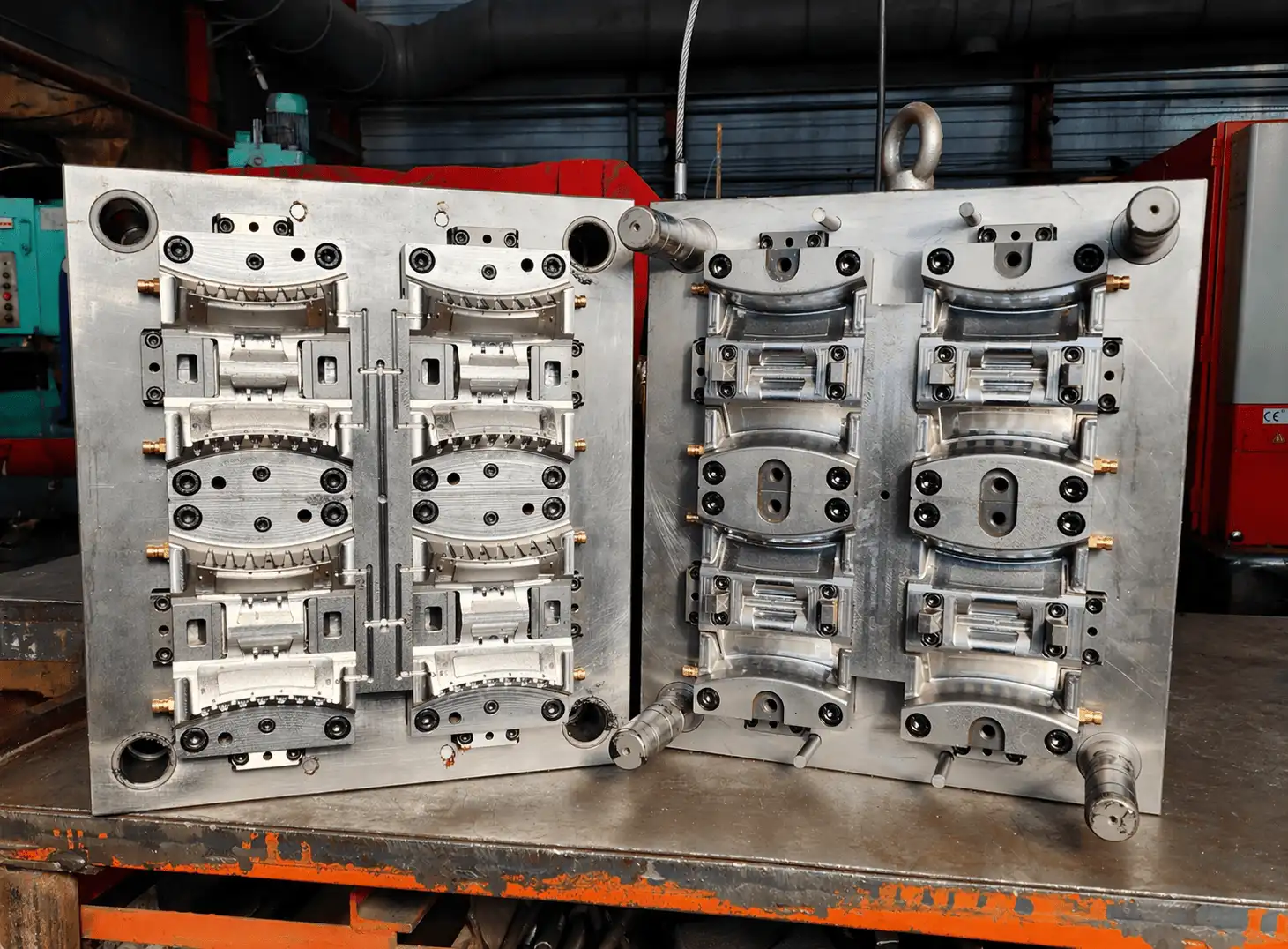
Mold making is not only about CNC milling, EDM, and grinding. The final result — repeatable molding in series — depends heavily on how the mold is assembled, fitted, and inspected.
It is common to see a situation where every component “matches the drawing”, but the mold still produces flash, mismatch, sticking, unstable dimensions, or quickly starts wearing in production. The reason is simple: in a mold, the interfaces matter as much as the parts themselves.
Below is a practical view of what drives repeatability during mold assembly: flatness, parallelism, guiding alignment, shut-off contact, lapping/spotting, and mandatory inspection steps.
Why “perfectly machined” parts sometimes don’t work together
A mold is a system of many parts where small deviations add up. Typical reasons why a mold may “not run” even with accurate machining:
- Tolerance stack-up across plates, spacers, and inserts (the mold closes, but not where it should).
- Non-uniform contact on parting and shut-off surfaces (local high spots create gaps elsewhere).
- Residual stress / distortion after heat treatment or EDM (a plate or insert is “within size”, but warped).
- Burrs and micro-edges on critical faces (a tiny burr can lift an insert and create mismatch).
- Guiding misalignment (pillars/bushings are sized correctly, but centerlines are not coaxial in assembly).
- Incorrect functional clearances for moving elements (ejectors, sliders, lifters).
- Surface finish not matching function (too rough → wear; too smooth → sticking; wrong finish on shut-offs).
Good assembly is the point where these issues are either caught and corrected — or passed into production.
Key geometry to control during mold assembly
Flatness and parallelism of closing surfaces
Flatness and parallelism are the foundation for stable clamping and parting-line quality. Critical surfaces typically include:
- base plates and support plates;
- insert seating faces;
- parting line faces (A/B plates);
- stop surfaces and spacers that define the closed height.
If the mold closes “on a corner” or on a few high points, it can lead to:
- flash in some areas and over-compression in others;
- uneven venting behavior;
- unstable part dimensions due to changing clamp load distribution.
Practical approach: verify flatness/parallelism on reference surfaces, then confirm actual contact pattern in assembly (see spotting below).
Guiding alignment: pillars and bushings
Guides do more than “help close the mold”. They define how consistently A and B halves align.
What matters in practice:
- coaxial alignment of pillar/bushing pairs across plates;
- correct seating of guide components (no tilt);
- smooth motion without tight spots over the full stroke.
If guiding is not aligned, you may see:
- mismatch (step) on the parting line;
- accelerated wear of shut-offs and parting faces;
- sliding elements binding or wearing unpredictably.
Shut-off surfaces: where fit beats numbers
Shut-offs and interlocks are “functional seals”. They must close reliably to prevent flash and preserve geometry.
Key points:
- shut-offs must have the right contact area and direction (to resist injection pressure);
- contact should be stable after warm-up, not only at room temperature;
- sharp transitions and thin lands tend to wear faster.
A common mistake is trying to “solve” flash by simply increasing clamp force — which can shorten mold life. The better solution is a correct shut-off fit and contact.
Ejection system: repeatability starts with smooth motion
Ejector pins and sleeves are often machined accurately, but the system can still behave poorly if:
- ejector plate guidance is misaligned;
- pin holes have burrs or incorrect finish;
- clearances are too tight for thermal growth and contamination;
- return pins and stops are not fitted properly.
Symptoms in production include part sticking, ejector marks, and inconsistent ejection force — all of which influence repeatability and surface quality.
Sliders, lifters, wedges: where “hand fitting” is justified
Moving elements add complexity, because they combine:
- guiding (contact surfaces),
- sealing (shut-offs),
- timing (mechanical sequence),
- wear behavior.
Here, careful fitting and inspection typically saves the most time during tryout. The goal is not “maximum tightness”, but predictable motion and stable shut-off contact after many cycles.
Spotting and lapping: when it is needed and how not to overdo it
Spotting (checking contact with marking compound) and controlled lapping/fitting are classic operations in toolmaking. They are useful when you need to achieve a uniform contact pattern on:
- parting surfaces;
- shut-offs;
- insert seats;
- interlocks.
Good practice:
- spot first, remove only high points, and re-check;
- keep the removal controlled and minimal;
- protect reference surfaces and datums;
- confirm the result in actual assembly, not only on the bench.
What can go wrong:
- over-lapping can change geometry and create new mismatch;
- uncontrolled handwork can “move” datums and shift cavity position;
- removing material in the wrong zone can reduce shut-off strength.
The best fitting work is the one you can measure and repeat — not the one you do “until it looks good”.
Mandatory inspection steps before mold tryout
A structured inspection before the first tryout (or after repair) prevents wasted time on the press.
A practical checklist:
- Cleaning and deburring: remove chips, EDM soot, burrs on holes and seating faces.
- Dry assembly check: verify that all plates sit correctly, no rocking, no gaps.
- Guiding test: smooth closing/opening without binding; check over full stroke.
- Contact verification: parting/shut-off spotting where applicable.
- Motion test of moving elements: sliders/lifters/ejectors cycle smoothly with lubrication.
- Cooling circuit check: pressure/leak test, correct connections, no restrictions.
- Dimensional control of critical datums: inserts seating, cavity/core position, key distances (CMM or gauges when needed).
- Safety and standardization: correct fasteners, stops, return pins, limiters, and labeling.
This routine usually costs less than one failed tryout shift.
What most often causes problems in serial production
Even if the first samples look acceptable, issues often appear after the mold runs for a while. Common causes:
- Flash growth over time → wear of shut-offs/interlocks, poor contact distribution, contamination.
- Mismatch on the parting line → guiding wear or misalignment, unstable seating of inserts.
- Sticking / unstable ejection → incorrect surface finish, insufficient draft, ejector alignment problems.
- Part dimension drift → thermal behavior, uneven clamp load distribution, unstable insert seating.
- Rapid wear of moving elements → poor lubrication paths, wrong contact geometry, debris in guides.
Most of these are not “machine problems” — they are assembly/fit and inspection problems that show up under cycle load.
How to reduce handwork and speed up mold launch
The goal is not to eliminate fitting completely — it is to make it predictable and minimal.
What usually helps:
- define clear reference datums and keep them protected throughout manufacturing;
- plan grinding/finishing for critical closing and seating faces;
- use proper allowances for heat treatment and EDM, then finish on functional surfaces;
- verify guiding alignment and contact early, before final polishing;
- standardize components (guides, ejectors) and follow correct installation practices.
Need mold assembly, fitting, or mold repair support?
Promservice provides a full cycle of mold manufacturing — from machining (CNC, EDM, grinding) to assembly, fitting, and tryout preparation. If your mold needs restoration or stable repeatability in series, we can help with inspection, fitting of critical interfaces, and functional verification before production.