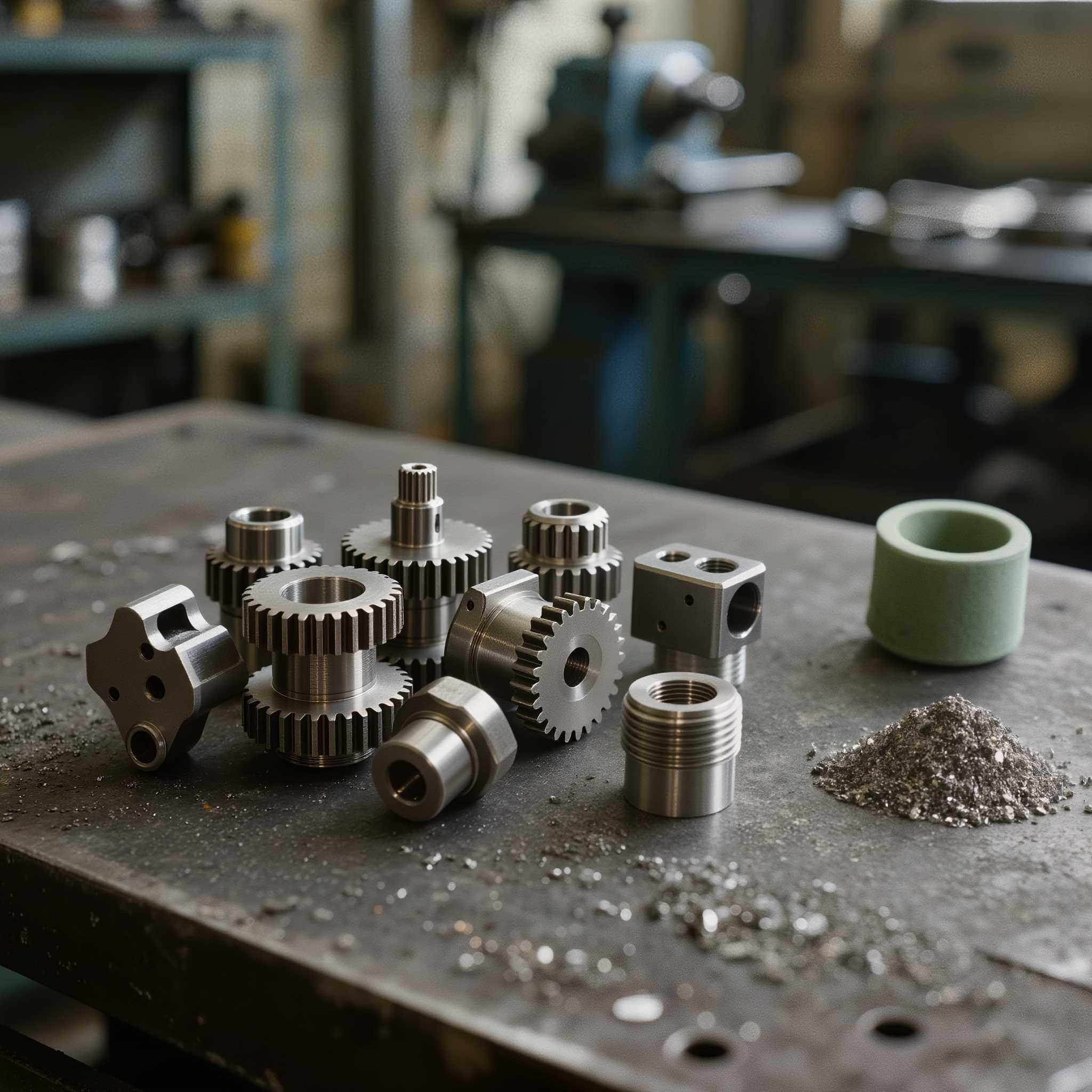
When you need to produce complex small metal parts in high serial volumes, classical machining often becomes expensive or simply inefficient. Each milling or turning operation takes time, and complex geometry requires expensive fixtures or extra setups. In such cases, MIM — Metal Injection Molding comes into play.
The technology combines the advantages of plastic injection molding (high productivity, complex geometry, repeatability) with the mechanical properties of metal after sintering. Promservice includes MIM in its lineup of injection molding technologies — alongside plastic injection molding on IMM — and helps customers choose the right approach for the task.
What is MIM in simple terms
Metal Injection Molding is a process in which a metal powder is mixed with a polymer binder and pelletized into so-called feedstock. The feedstock is then injected into a mold on an IMM — just like ordinary plastic. The result is a green part that visually looks like a plastic part.
After molding, the part goes through two key steps:
- Debinding — removing the binder (chemical, thermal, or combined). The part becomes porous — this is the brown part.
- Sintering — heating in a special furnace, during which the metal densifies and acquires properties close to forged or cast metal.
The finished part has near net-shape geometry, high accuracy, and structural integrity. Typically it requires minimal post-processing — or none at all.
How MIM differs from other technologies
MIM occupies a unique niche between several established technologies:
- Versus machining — MIM forms the part directly, without removing material. Waste is minimal.
- Versus traditional metal casting — MIM delivers far more complex geometry and better dimensional repeatability for small parts.
- Versus conventional powder metallurgy (PM) — MIM uses finer powders, gives higher part density and more complex geometry.
- Versus metal 3D printing — MIM is more cost-effective in serial production thanks to faster cycles and lower per-part cost at scale.
In short: if you need many complex small metal parts, MIM often wins on cost.
What parts MIM is the best fit for
MIM is most effective when several characteristics align.
Part size. Typically small to medium-sized parts, from a few millimeters up to 5–10 cm. Mass — from fractions of a gram to about 100 g (sometimes more).
Complex geometry. Parts with:
- internal grooves and slots;
- threads, angled holes;
- ribs, bosses, complex radii;
- combinations of surfaces that are difficult or expensive to mill;
- thin walls and precise features.
High volumes. MIM pays off in serial production — tooling cost is comparable to plastic injection molds, so a sufficient quantity is needed to amortize it.
Demanding material requirements. Unlike many plastics, MIM parts offer full metal properties: strength, hardness, corrosion resistance, the option to heat-treat.
Typical MIM applications
MIM parts find use across many industries:
- medical devices and instruments — surgical components, small housings, precise parts;
- electronics — small enclosures, frames, contact assemblies, connectors;
- precision mechanics — lock mechanisms, miniature assemblies, functional small components;
- automotive components — small parts in stainless or specialty steels;
- watches and optics — precise small parts with quality surfaces;
- tools — heads, holders, adapters;
- industrial assemblies — small valve, pump, lock components.
The common pattern: complex, small parts in high volumes with full metal property requirements.
Materials used in MIM
A wide range of metal powders is used in MIM:
- stainless steels (316L, 17-4PH, 304L, and others) — the most popular choice for corrosion-resistant parts;
- low- and medium-alloy steels — for structural parts with subsequent heat treatment;
- tool steels — for wear-resistant parts;
- iron-based alloys with additives — for specific mechanical properties;
- titanium alloys — for medical and aerospace use;
- carbides and ceramic-metal composites — for special applications (CIM/MIM).
Material choice depends on part function, strength and corrosion requirements, and service temperature.
MIM advantages over machining
MIM wins over machining in specific classes of parts:
- complex geometry in one shot — no refixturing or extra operations;
- low material waste — unlike milling, where part of the metal becomes chips;
- fewer operations — the part is often ready without further processing;
- batch repeatability — like plastic molding;
- good surface — after sintering, parts have quality surfaces without tool marks;
- economy at scale — per-part cost is much lower than machining in high volumes.
When MIM loses to machining
MIM is not universal. Machining is the better choice when:
- small batches or single parts — tooling cannot be amortized;
- large parts — MIM mainly suits small parts;
- very tight linear tolerances on critical dimensions — often require finishing;
- specific materials not available as MIM powders;
- prototypes and test samples — faster and cheaper on CNC.
In real projects, MIM and machining often complement each other: a "green" MIM part can receive finish machining of critical surfaces.
MIM part accuracy
Geometric accuracy of MIM parts is typically:
- linear dimensions — around ±0.3–0.5% of the dimension (typical);
- tighter tolerances — achievable with constraints or through post-processing;
- surface finish — Ra about 0.8–1.5 µm (better than casting, lower than grinding).
Shrinkage during sintering is about 15–20% and must be accounted for in mold design. This makes MIM tooling somewhat more complex to design than a plastic mold — the cavity is deliberately oversized to compensate for shrinkage.
For critical surfaces (fits, threads, mating features), finish machining after sintering is a common and accepted practice.
What a typical MIM project looks like
A typical project cycle:
- Part and manufacturability review. Check geometry, mass, gate locations, shrinkage risks, process constraints.
- Material and feedstock selection. Choose metal powder and binder, agree on post-sinter properties.
- Mold design. Account for sintering shrinkage (the mold is about 15–20% larger than the final part).
- Mold manufacturing. In-house at the toolroom.
- Trial molding of green parts. Check geometry, surface, absence of internal defects.
- Debinding and sintering. Furnace cycles controlled to reach target properties.
- Post-processing (if needed). Calibration, grinding, finishing of critical surfaces.
- Quality control and serial production. Dimensional measurement, structural inspection, release of finished batches.
Why MIM is a distinct competence
MIM combines knowledge from three areas: mold engineering, polymer injection molding technology, and powder metallurgy. This is an unusual combination — only a limited number of companies in Ukraine offer it.
Promservice includes MIM in its injection molding lineup alongside plastic molding and direct compression molding. This allows us to:
- advise the customer on which technology — plastic molding, MIM, or machining — is optimal for the specific part;
- design MIM molds with shrinkage and sintering in mind;
- manufacture tooling in our own toolroom;
- perform finish machining of MIM parts where required.
MIM or machining: a short summary
Simplified:
- MIM — choose if you need many complex small metal parts with a good surface, and you can invest in tooling.
- CNC machining — choose for single parts or mid-volume batches, prototypes, larger parts, or parts with very tight linear tolerances.
In ambiguous cases it pays to evaluate the project from both sides: Promservice engineers can assess both options and recommend the best fit.
Need MIM consultation in Ukraine?
Promservice provides Metal Injection Molding (MIM) services and helps select the right technology for your part. Send drawings, a 3D model, or a sample — we will evaluate manufacturability, compare MIM with machining, and offer a solution with the best cost per part at your volume.