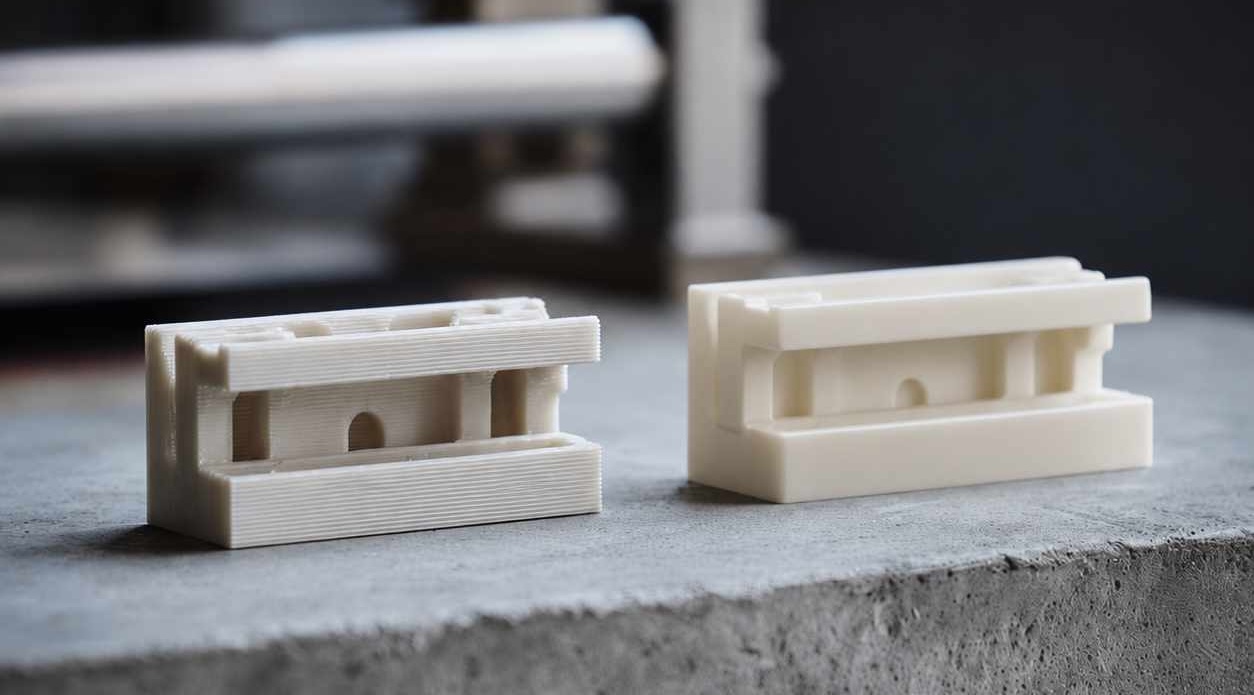
3D printing makes it possible to produce a plastic part quickly without permanent tooling: prepare the model, select the process and material, and make a sample or a small batch. This raises a logical question: do you need an injection mold if the part can be printed? The answer depends not only on quantity, but also on geometry, material, quality requirements, lead time, and the total economics of the project.
For prototypes, validation samples, and designs that change frequently, 3D printing is often the more practical option. For stable series production, injection molding can provide a lower unit cost, a repeatable process, and access to a broad range of industrial polymers. Promservice designs and manufactures injection molds, performs mold trials, and produces plastic parts on injection molding machines in Ukraine.
3D printing: cost structure and low-volume flexibility
The main advantage of 3D printing is the absence of investment in a metal mold. This reduces initial cost and makes design changes easier to implement.
The cost of a printed part typically includes:
- model preparation and production setup;
- print time and machine capacity;
- material: filament, resin, powder, or another process-specific material;
- support removal, cleaning, curing, and finishing where required;
- quality control, scrap, packaging, and logistics.
The first part does not always cost exactly the same as the hundredth: some operations can be optimized when a batch is printed. However, economies of scale are usually much weaker in 3D printing than in injection molding. Total cost often grows close to the number of parts and depends on printer throughput, the ability to run jobs in parallel, and the amount of post-processing required.
Injection molding: initial investment and variable cost
Injection molding requires an upfront investment in tooling, but once the process is validated and stabilized, the cost per part can decrease as production volume grows.
A realistic calculation should include:
- design-for-manufacturing review, mold design, and mold manufacturing;
- mold trials, corrections, and fine-tuning;
- material and process scrap;
- injection molding machine time, energy, labor, or automation;
- quality control, packaging, mold maintenance, and logistics.
An injection molding cycle may take seconds or minutes, depending on part size, wall thickness, polymer, cooling, and mold design. Unit cost should therefore not be reduced to “material plus cycle”: cycle time must be translated into the cost of equipment and the complete production process.
Break-even point: how to compare the processes correctly
The break-even point is the quantity at which the total cost of 3D printing and injection molding is the same.
A simplified formula is:
Break-even quantity = initial tooling cost / (3D printing cost per part − variable injection molding cost per part).
Initial tooling cost should include more than the mold price: it normally includes engineering, trials, and fine-tuning. Variable molding cost should include material, machine time, labor, quality control, process scrap, and other costs that grow with production volume.
When the variable cost of a molded part is not lower than the cost of a printed part, the mold will not pay back through unit-cost savings alone. It may still be justified by requirements for material, surface finish, repeatability, assembly, or output capacity.
There is no universal volume at which injection molding is always more cost-effective than 3D printing. The break-even point changes with the printing process, part size and complexity, material, quality requirements, mold design, and planned production period. Compare the expected lifetime volume of the product, not only the first order.
When 3D printing is usually the better choice
3D printing is often a good choice when:
- prototypes and validation samples are needed before the design is finalized;
- volume is low or the part changes regularly;
- several versions must be made quickly to verify geometry, fit, or assembly;
- the product is unique or requires personalization;
- the geometry includes features that cannot be molded, or cannot be molded economically;
- spare parts or a limited batch are needed without investing in permanent tooling.
In these cases, flexibility and speed from model to part matter more than the lowest possible unit cost.
When injection molding is usually the better choice
Injection molding should be considered when:
- the forecast production volume is above the calculated break-even point;
- the part design is stable and does not require frequent changes;
- dimensional repeatability and process stability are important in a series;
- specific engineering polymer grades, filled compounds, or documented material properties are required;
- the part needs a defined surface finish without pronounced layer-build marks;
- throughput and unit cost matter in regular production.
Even at relatively low volume, a mold may be justified when alternative processes cannot meet the required material, geometry, appearance, assembly requirements, or output capacity.
Quality and properties: compare specific processes, not broad labels
3D printing is not one process. FDM/FFF, SLA, SLS, MJF, and other technologies deliver different mechanical properties, accuracy, and surface quality. A useful comparison between “3D printing” and injection molding must therefore be based on a specific part, material, and manufacturing process.
- Material structure. Mechanical properties in FDM/FFF parts often depend on print orientation and interlayer bonding. Molded parts have continuous material, but their properties can also vary with flow orientation, weld lines, fillers, and processing conditions. Neither process should be treated as automatically fully isotropic.
- Surface finish. A molded part reproduces the polish or texture of the mold surface. In 3D printing, the result depends on the process: layer lines, roughness, support marks, or powder residue may require further finishing.
- Accuracy and repeatability. With a properly engineered mold and a controlled process, injection molding can produce a stable series. In 3D printing, results depend on the technology, part orientation, shrinkage, equipment calibration, and post-processing.
- Materials. Injection molding offers a wide choice of industrial thermoplastics and filled compounds. The portfolio of printable materials is also expanding, but suitability and documentation for a specific application should be checked separately.
A hybrid approach: do not treat the choice as “either/or”
In many projects, 3D printing and injection molding complement one another:
- 3D-printed prototype → injection-molded series. Several iterations help validate the design before the mold is built and reduce the risk of expensive tooling changes.
- 3D printing as a bridge. While the mold is being manufactured, small batches of printed parts can be supplied when they meet the product’s functional and quality requirements.
- 3D printing for support tooling. Jigs, templates, holders, and assembly aids can be printed while the primary parts are produced by injection molding.
This approach can shorten the path to market and enable an economical production series once the design is stable.
How Promservice helps you choose the process
Promservice evaluates more than the price of one part: we look at the full route from model to series production. We can:
- analyze the part, material, quality requirements, and expected production volume;
- assess manufacturability and key risks before production starts;
- prepare the input data needed to estimate the break-even point;
- advise when it is appropriate to move from 3D printing to injection molding;
- design and manufacture an injection mold based on material, expected mold life, cavity count, and required output;
- perform mold trials and fine-tuning;
- manufacture serial plastic parts on our own injection molding machines.
Need an estimate for a mold and injection molding?
Send us a drawing or 3D model, information about the material, part requirements, and expected production volume. Promservice specialists will assess the part’s manufacturability, help select the mold design and cavity count, and prepare the initial data needed to evaluate the tooling payback.
We provide a complete production cycle: mold design and manufacturing, mold trials and fine-tuning, as well as serial production of plastic parts on our own injection molding machines.