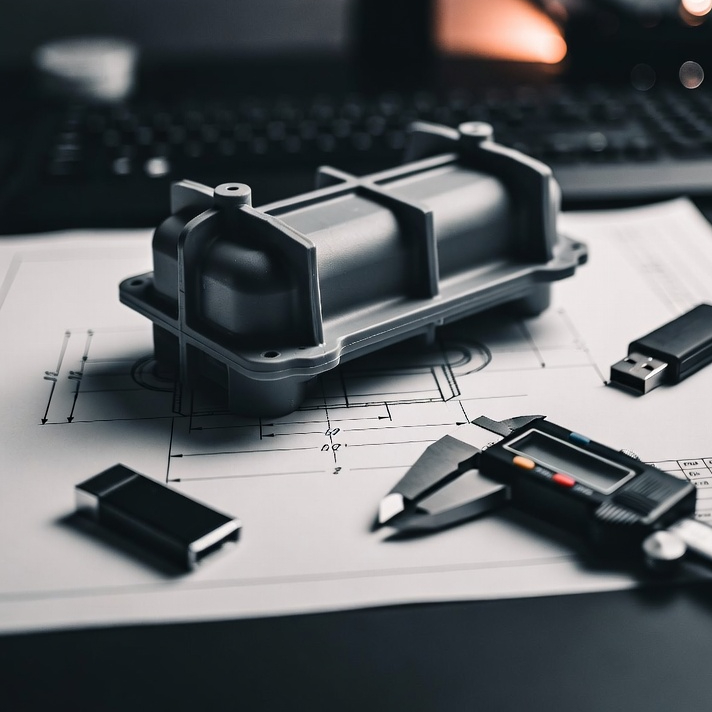
A typical inquiry starts with the phrase "we need a plastic part molded." No injection molding cost estimate can be produced from that: there is no geometry, no material, no volume, and no indication of whether a mold already exists. What follows is several days of email traffic, while the customer concludes the manufacturer is "taking forever to think."
Below is a practical checklist of input data: what exactly to send, why each item affects the price, and what to do when there are no drawings and no 3D model at all. This article is about what to put in the email, not about what makes up the price of a molded part. Promservice designs and builds molds and runs injection molding on its own fleet of molding machines, so this is precisely the data set that lets a project be quoted quickly.
Why a quote stalls without input data
The price of a molded part is the result of several linked decisions: mold design, number of cavities, material, cycle time, secondary operations. Every missing parameter leads to one of two scenarios, and neither works in the customer's favor.
- A follow-up question. The manufacturer asks, the answer arrives the next day — three missing items easily turn into a week.
- An assumption. To keep things moving, the quote is built on averages. When the real conditions surface, the price changes — and that looks like renegotiating what was agreed.
Step 1 — Part geometry: the 3D model
The basis of any estimate is the 3D model. It is used to assess shot weight, projected area and the required clamping force, wall thickness, the complexity of the molding surfaces, and the need for moving units.
- STEP (.step, .stp) — the most convenient format: neutral, exact geometry, opens in any CAD system.
- IGES, Parasolid — acceptable alternatives, occasionally with minor surface errors.
- Native formats (SolidWorks, Inventor, Creo) — suitable when preserving parametric data matters.
- STL — the worst option: a triangulated shell, exact geometry lost, circles become polygons, radii and threads cannot be reconstructed correctly. Still better than nothing: overall size and configuration are visible.
- Model status. Indicate whether it is final or preliminary: a preliminary model can be quoted too, but with a note that the estimate will be revised once the geometry changes.
Step 2 — Drawings: critical dimensions and tolerances
The model shows the shape but not the requirements. Only the drawing explains where precision is needed and where it isn't; without it, an allowance has to be built in everywhere, and that directly raises tooling cost. A full drawing package isn't mandatory — a sketch or a screenshot of the model with dimensions marked is enough.
- critical dimensions and their tolerances: fits, center distances, thicknesses;
- datums and the fixturing scheme used for inspection;
- surface roughness requirements;
- threads: molded in, tapped, or produced with inserts;
- what can be changed at the manufacturer's suggestion and what must not be changed.
Step 3 — Material or operating conditions
The ideal case is a specific polymer grade and producer, if the material is fixed by specification. If there is no grade, describe the part's operating conditions and the material will be selected to suit the task.
- operating and peak temperature, duration of heating;
- loads: constant, cyclic, impact;
- contact with chemicals, fuel, lubricants, cleaning agents;
- UV exposure, moisture, outdoor use, food contact or medical application.
State separately whether fillers are required (glass fiber, talc, mineral), plus flame retardants, antistatic additives, and whether recycled material is acceptable. Promservice works with polyolefins, styrenics, polyamides, polycarbonates, polyurethanes, fluoropolymers, polyester and filled compounds.
Step 4 — Color and appearance requirements
Appearance affects the material, the mold design, and the scrap rate in production. "It has to look good" says nothing, while "the show surface is VDI 27 matte, ejector pin marks on the inside only" defines the tooling immediately.
- color per RAL, Pantone or a supplied sample; whether shade deviations are acceptable;
- finish: gloss, matte, texture per SPI or VDI;
- whether ejector pin marks are acceptable and the areas where they are not wanted;
- whether visible weld lines are acceptable, the preferred or forbidden gate location and the appearance of its witness mark;
- which surfaces are visible in the finished product and which are hidden by other parts.
Step 5 — Volume and production schedule
One of the most influential items: the number of cavities and the runner system type follow directly from volume. For small series a single-cavity cold runner mold is rational; for large series a multi-cavity hot runner mold — more expensive tooling, but a substantially lower piece price.
- annual requirement in pieces;
- batch size and shipment frequency;
- expected product life cycle;
- initial batch and forecast volume growth.
Step 6 — Tooling: new, existing or modified
The status of the mold changes the structure of the whole project, so state it upfront.
- a new mold is required — both tooling and production are quoted;
- you have your own mold — its dimensions, type, condition, the molding machine it was designed for, and availability of drawings are needed;
- modification or repair is required — reworking cavities, replaceable inserts, improved cooling or venting;
- who will own the mold and where it will be stored between runs: Promservice stores molds on its own premises and maintains them throughout their service life.
Step 7 — Insert components and assembly
If the part isn't purely plastic, this needs to be stated in the inquiry, not after the quote.
- metal bushings, threaded inserts, contacts, magnets, reinforcing elements;
- the need for insert molding — molding inserts directly in the mold — or ultrasonic insertion after molding;
- assembly of a unit from several parts, bonding, welding;
- who supplies the insert components — the customer or the manufacturer.
Step 8 — Secondary operations, marking and packaging
- gate removal: manual, automatic, or not required at all;
- marking: engraving in the mold, laser, pad printing; painting and decoration;
- functional checks and testing, if they are required;
- packaging: bags, boxes, dividers, quantity per box, palletizing and pallet labeling.
Step 9 — Quality, documentation and delivery terms
Inspection requirements determine the scope of measurement and paperwork, and therefore the cost of every batch. Promservice operates under an ISO 9001:2015 quality system, and export deliveries are a routine scenario for us.
- acceptable quality level (AQL) or the need for 100% inspection;
- measurement reports for critical dimensions;
- the need for PPAP or FAI if the industry requires it; material certificate, batch certificate, traceability;
- delivery location, target date for production start, shipment schedule, export.
If there is neither a 3D model nor drawings
A common situation: the part is old, the documentation was lost or never existed. Working under these conditions is entirely feasible.
- a physical sample — the fastest route; even a worn or broken part works if the main geometry survived;
- photos from different angles with a ruler or caliper in frame and captions such as "this is the datum," "this hole is critical";
- a hand sketch with key dimensions and overall size;
- the old part plus a description of what was unsatisfactory: wear, cracks, insufficient strength, warpage.
Measurement follows, 3D scanning if needed, and a model is developed — reverse engineering. One caveat: a sample doesn't reveal which dimensions were critical and which were incidental, so their list and tolerances are agreed separately, before the tooling is made.
What you get in return
- manufacturability comments (DFM): wall thickness, draft angles, radii, likely weld lines, gate locations;
- a proposal for the mold design and the number of cavities matched to your volume;
- the tooling cost;
- the piece price in production for the stated batch sizes;
- lead times for tooling and for reaching serial production;
- terms for mold maintenance, repair and storage.
Consolidated checklist for your email
- 3D model in STEP (or IGES, Parasolid, native format) marked "final" or "preliminary."
- Drawing or sketch with critical dimensions, tolerances, datums, roughness, threads.
- Material: grade and producer — or operating conditions for selection, plus fillers and additives.
- Color per RAL/Pantone or a sample, finish per SPI/VDI, visible surfaces, acceptability of ejector pin marks and weld lines.
- Annual requirement, batch size and frequency, initial batch, product life cycle.
- Tooling: new, already in your possession, or in need of modification; owner and storage location.
- Insert components, insert molding, assembly, welding, bonding.
- Secondary operations, marking, packaging, palletizing.
- Inspection and documentation requirements, delivery location, lead times, shipment schedule, export.
Common mistakes in an inquiry
- Sending photos only of the part, with no dimensions and no sample.
- Sending STL instead of STEP and expecting an exact estimate of dimensions and tolerances.
- Omitting the volume — the number of cavities and runner system type then cannot be determined.
- Writing "some kind of strong plastic" instead of the operating conditions.
- Saying nothing about color and appearance, then demanding a gloss finish with no marks.
- Forgetting the insert components and unit assembly.
- Not mentioning that a mold already exists — and receiving a quote that includes new tooling.
- Not flagging critical dimensions: a precision allowance is built in everywhere and the tooling gets more expensive.
- Changing requirements after receiving the quote and expecting the price to stay the same.
How Promservice helps at the quoting stage
We get involved before any tooling exists — at the stage of preparing the input data:
- we analyze 3D models, drawings or a sample and list the data that is missing;
- we perform DFM analysis: wall thickness, draft angles, radii, gate locations, likely weld lines;
- we select a polymer to match the operating conditions if no grade is specified;
- we propose a mold design and the number of cavities for your volume — cold or hot runner;
- we measure the sample and develop a 3D model if no documentation exists;
- we design and build the tooling in-house: CNC milling, EDM, grinding, polishing, assembly and fitting;
- we provide trial runs, serial molding on our machines, and subsequent mold repair, maintenance and storage.
Need an injection molding cost estimate?
Send a 3D model in STEP, a drawing with the critical dimensions, your material and color requirements, and an approximate annual volume — that is enough for us to produce an injection molding cost estimate together with a tooling quote. If you have no model and no drawings, send a sample or photos with dimensions: we will measure it and develop the model.
Promservice provides the full cycle — manufacturability analysis, mold design and manufacturing, trial runs, serial injection molding, and ongoing tooling service.