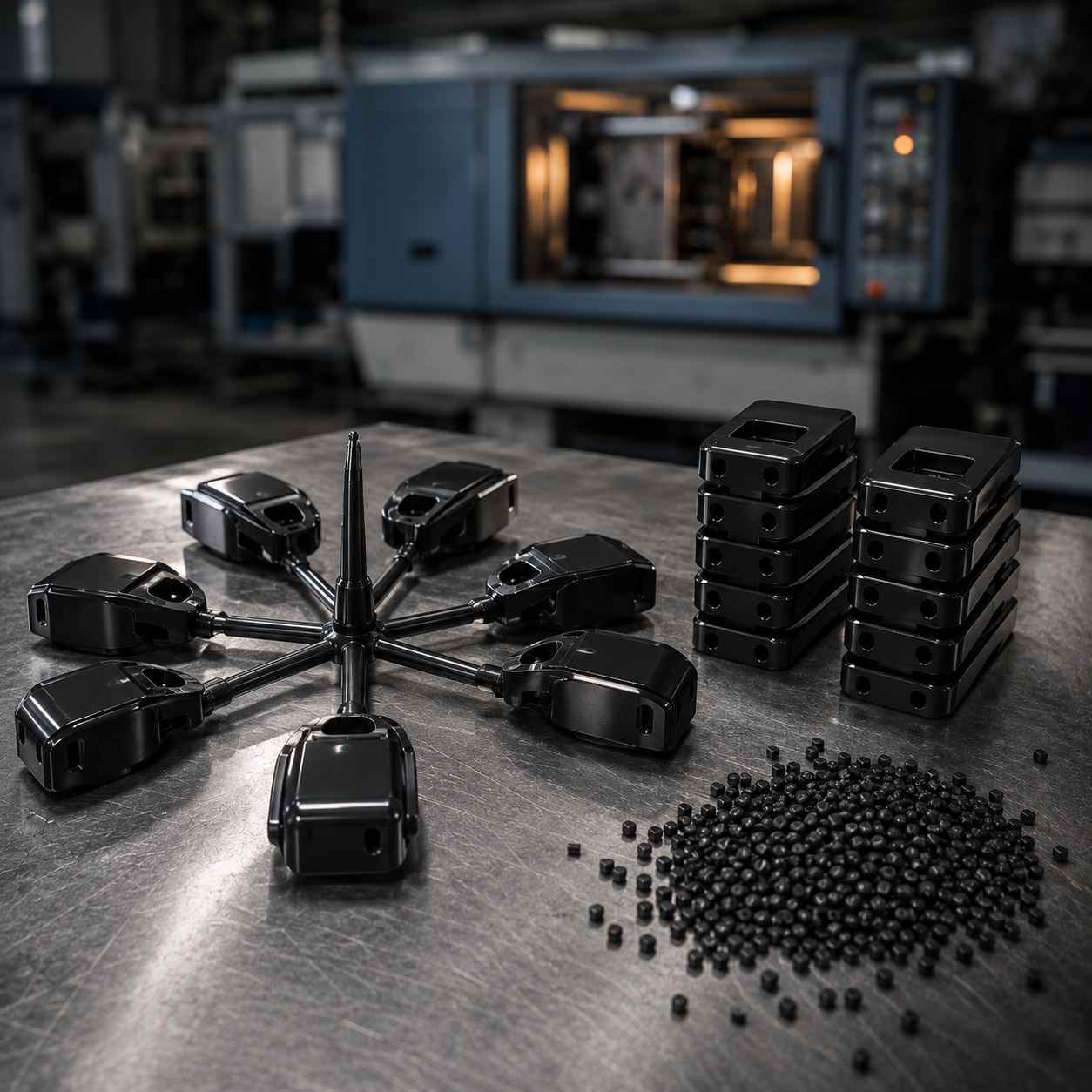
"How much does it cost to mold this part?" is one of the first questions any molding shop hears. And an honest answer starts not with a number, but with a list of clarifying questions. Injection molding cost per part is not a single rate per kilogram or per piece, but the sum of several independent components, each driven by part design, material, volume, and quality requirements.
In this article we break down the price structure of a molded part: what exactly the customer pays for, which factors matter most, and where the savings potential sits. Promservice runs the full cycle — from mold design to series production on its own fleet of injection molding machines — so it evaluates cost with both the tooling and the actual process in mind.
Why the price of a molded part isn't a single number
The price is made up of elements that are calculated by different logic and are largely unrelated to each other.
- Material. Part weight plus runner weight, multiplied by the cost of the specific polymer grade with additives and colorant.
- Machine time. Cycle time multiplied by the hourly rate of an injection molding machine of the appropriate tonnage.
- Tooling share. If the mold is built for the project, its cost is either paid separately or amortized across the production run.
- Secondary operations. Runner trimming, assembly, welding, marking, machining.
- Quality control. Measurement, visual inspection, reports, batch traceability.
- Packaging and logistics. Containers, pallets, delivery to the customer's warehouse.
- Scrap and changeovers. Start-up parts and process stabilization are real costs built into the price.
That's why two quotes for the "same" part can differ several times over: behind them are different technical specifications, different tooling, and different volumes.
Material: part weight plus runner weight
- The runner counts as material. With a cold runner, the runner system is molded every cycle. On small parts it can weigh as much as the part itself.
- Polymer class. Commodity materials (PE, PP, PS, ABS) cost less than engineering grades (PA, PC, POM), and far less than specialty polymers (fluoropolymers, high-temperature grades such as PEEK, PPS, PSU). Fillers change both the resin price and tool wear.
- Color. Masterbatch adds to the cost per kilogram, and a color change requires purging the barrel.
- Drying. Hygroscopic materials (PA, PC, ABS) require drying — that means time, energy, and dedicated equipment.
- Grade availability. If the specification rigidly calls out a rare grade, the price depends on the supply terms for that grade specifically.
- Regrind. Runners are often ground and returned to the process, but the regrind share is limited by property and color requirements, and for critical parts it may be prohibited outright.
Cycle time — the second major price driver
The machine component is simple math: cycle time multiplied by the machine hourly rate. In a large series, every second costs money.
- Wall thickness. The main factor: cooling time grows nonlinearly, so thickening a wall increases it far more than proportionally.
- Material thermal behavior. Semi-crystalline polymers require removing more heat than amorphous ones.
- Mold temperature and cooling. A well-designed channel layout with no dead zones gives a shorter and more stable cycle.
- Holding pressure. Packing compensates for shrinkage; cutting it back by guesswork means sink marks and dimensional scatter.
- Mold mechanics. Opening and closing time, ejection stroke, and slide movement add to every cycle.
- Automation. A take-out robot removes manual operations and levels out the cycle from run to run.
Machine tonnage and the machine hourly rate
The required clamping force is determined by the projected area of the part and runner on the parting line, multiplied by the specific pressure in the mold cavity. So the larger and "flatter" the part, the more tonnage is needed — even if the part itself is light — and the hourly rate of a bigger machine is higher.
The Promservice fleet consists of 22 machines from 50 to 650 tons (Arburg, Bole, Engel, Haitian). This makes it possible to run a mold on a machine of the right size and avoid paying for excess tonnage.
Number of cavities and the runner system
The number of cavities divides machine time by the number of parts: a four-cavity mold produces four parts per cycle, and the machine share per piece drops almost fourfold. But more cavities is not always cheaper: the mold costs more, filling balance is harder to hold, the projected area grows, and a larger machine is needed. The optimal number of cavities is calculated for the real annual volume, not "just in case."
The type of runner system affects material and cycle at the same time:
- Cold runner. The mold is cheaper and simpler to maintain, but the runner is molded every cycle: material consumption, trimming, and extra seconds of cycle time.
- Hot runner. No runner, a shorter cycle, automatic separation — but the mold is more expensive and needs skilled maintenance. Where the break-even point sits is shown by the hot runner payback calculation.
The mold's share in the part price
Tooling is a one-time investment that works for years. In the calculation it shows up in two ways:
- Mold owned by the customer. Paid for separately; the part price then covers only material, cycle, and related operations. More transparent and more economical at high volumes.
- Amortization in the part price. The mold cost is spread across an agreed production run: lower start-up costs, higher price per piece.
The rule is simple: the larger the run, the smaller the tooling share in the part price. The economics of the mold also include repair, maintenance, and storage between runs — Promservice performs this work at its own facility. And at what volume a mold begins to justify itself at all, we covered in a piece on mold payback.
Volume, batch size, and changeovers
Every production run has a fixed cost that doesn't depend on the number of parts: pull the previous mold, install the new one, bring the process to steady state, scrap the start-up parts. These costs are divided across the batch, therefore:
- small frequent batches are always more expensive per part;
- consolidating batches lowers cost with no design changes;
- annual volume and the delivery schedule matter more for price than a one-off order;
- a framework agreement for the year gives better terms than a series of separate small orders.
Secondary operations, packaging, and logistics
A part coming out of the mold is rarely the finished product. Every operation adds labor:
- runner trimming and cleaning up the gate area;
- molding with metal inserts (insert molding) — placing the inserts lengthens the cycle;
- assembly of subassemblies and ultrasonic welding;
- applying markings, including laser marking, painting, and decoration;
- machining of holes, threads, and mating surfaces;
- functional testing — leak tightness, force, subassembly performance.
Packaging and logistics are calculated separately: part volume and weight, container type, palletizing, delivery route within Ukraine or for export. Packing each part individually costs considerably more than bulk packing in standard containers.
Quality and inspection requirements
- Tight tolerances. A narrow process window means more measurements, more careful setup, and a higher rejection rate.
- Inspection scope. Sampling inspection and 100% inspection differ in labor intensity.
- Documentation. Measurement reports, batch certificates, and traceability to the material lot require separate work.
- Industry requirements. Food contact, medical use, and electrical characteristics limit material choice and raise process requirements.
Promservice operates under an ISO 9001:2015 quality system and its own production process monitoring system, so the level of inspection is agreed in advance and built into the quote.
Part complexity and surface requirements
- Moving units and slides. Side holes, snaps, and undercuts require a more complex mold and add opening time.
- Threads. Unscrewing mechanisms are a separate tooling unit and a longer cycle.
- Thin walls and deep ribs. These need higher injection pressure, good venting, and sufficient draft angles — otherwise scrap goes up.
- Surface requirements. A mirror gloss or a specified texture means extra work on the molding surfaces and stricter process cleanliness requirements.
- Transparency. Clear parts show every defect, so rejection rates and polishing requirements are higher.
How to actually reduce the cost per part
The biggest effect comes from decisions made before the tooling is built.
- Revisit wall thickness. A uniform, minimally sufficient wall reduces part weight and shortens cooling — the two main price drivers.
- Drop non-essential requirements. A tight tolerance or a gloss finish where it serves no function is pure overpayment.
- Choose a more processable material. A cheaper polymer with better flow sometimes delivers both a lower resin price and a shorter cycle.
- Optimize the number of cavities for the real annual volume, not the maximum possible one; at high volumes, consider a hot runner.
- Consolidate batches. Fewer changeovers means lower fixed costs per part.
- Combine parts in one mold. A family mold makes sense when the parts are close in geometry, material, and required quantity.
- Improve mold cooling. A well-designed channel layout shortens the longest part of the cycle.
- Design the part for an automatic take-out robot. This removes manual operations and stabilizes the cycle.
Common mistakes in cost estimation
- Comparing quotes without a comparable technical specification. Different material, number of cavities, and inspection scope make the numbers incomparable.
- Looking only at the part price. Tooling, its repair, storage, and service are part of the overall project economics.
- Ordering for peak volume. A mold sized for a run that doesn't exist yet takes years to pay off.
- Cutting corners on a mold for a large run. Cheap tooling with a short service life ends in repairs, downtime, and scrap.
- Ignoring the cost of scrap and stoppages. An unstable process eats up all the savings gained at the start.
What you need to provide for a quote
For the estimate to be realistic, a minimum data set is needed:
- a 3D model of the part;
- a drawing with tolerances and critical dimensions marked;
- material — a specific grade or property requirements;
- annual volume and delivery schedule;
- color and surface requirements;
- tooling information — an existing mold or one to be built;
- a list of secondary operations, packaging requirements, and delivery location.
These items are already enough for a well-founded quote; and if you would rather settle it in one go, with no follow-up emails, there is a full checklist of data for an inquiry.
How Promservice helps calculate and reduce the part price
- we review the 3D model and drawing for manufacturability and point out exactly what is driving the cost up;
- we select a material for the service conditions, factoring in cost and behavior in the mold;
- we calculate the optimal number of cavities and runner system type for the real annual volume;
- we match the injection molding machine from our 50–650 ton fleet without overpaying for excess tonnage;
- we design and build the mold at our own tool room;
- we perform secondary operations — insert molding, assembly, marking, machining, packaging;
- we run series production with quality control, plus mold repair, upgrades, and storage.
This approach gives the customer not just a number, but a clear cost structure that shows what can be influenced.
Need a molding cost estimate for your part?
If you need to understand the injection molding cost per part for a specific product, contact Promservice. Send a 3D model, drawing, or sample, specify the material, planned volume, and quality requirements — we'll assess the job, show the price structure of the part, and propose solutions that reduce cost in series production.