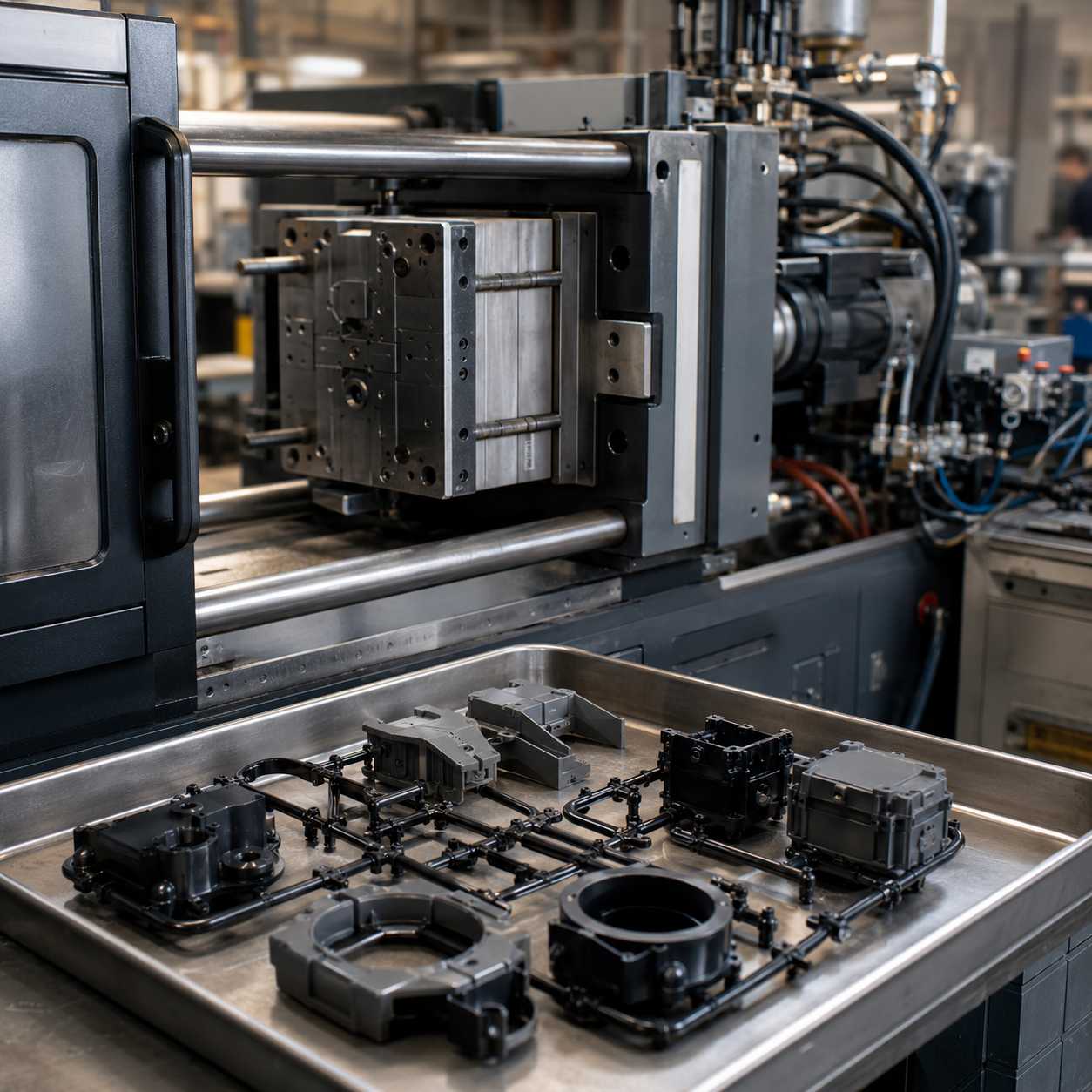
Many companies need plastic parts — housings, technical assemblies, product components, packaging, or specialized parts — but running their own injection molding facility is not economically justified. An in-house fleet of injection molding machines, a tool room, process engineers and operators are fixed costs that only pay off at consistently high volumes across a broad part mix.
This is why contract injection molding on IMM (injection molding machines) has become the preferred model for many manufacturers: the customer focuses on the product and the market, while the partner handles tooling, molding, quality control, and service. Promservice operates exactly in this model — from mold design and toolmaking to serial production and ongoing technical support.
What is contract injection molding?
Contract molding is a service where a specialized manufacturer performs injection molding of plastic parts on its own equipment according to the customer's specification. Depending on the agreement, the contractor may provide:
- mold design, manufacturing, or modernization;
- material sourcing or processing of customer-supplied resin;
- injection molding on IMM with controlled process parameters;
- quality control and packaging of parts;
- on-site storage and scheduled maintenance of tooling;
- delivery of finished goods to the customer's warehouse.
This model allows a customer to start serial production without capital investment in their own injection molding machines and tool shop.
When contract molding makes sense
Outsourcing injection molding is usually the right move when:
- volumes are serial or mid-volume, not high enough to justify a dedicated line;
- the part mix is wide with different materials and cavitations;
- demand is unstable and an in-house line would sit idle;
- a new product launch needs to reach the market quickly without CapEx;
- the company lacks in-house competence in molding and tooling;
- the production floor is limited and cannot host an IMM cell;
- the team needs to stay focused on R&D, marketing, assembly, or sales.
For many customers, a contract with a reliable molder is a faster and cheaper way to reach a stable serial run than building their own facility.
What the customer gets from Promservice
Promservice is a manufacturing partner that combines an in-house toolroom with a fleet of injection molding machines. This means tooling and molding are not split between separate contractors — they are managed in a single cycle.
The customer gets:
- engineering support at the start — drawing review, recommendations on material, part design, and manufacturability;
- mold design and manufacturing with the right cavitation, runner system (hot or cold), cooling, and venting for the expected volumes;
- trial runs and process setup before serial production;
- serial injection molding with dimensional, weight, and visual quality control;
- mold service through the entire life cycle — inspection, cleaning, repair, modernization;
- on-site mold storage;
- flexible volumes — from small batches to high-volume production.
This format removes the need to coordinate multiple contractors and eliminates the "split responsibility" risk between the tool maker and the molding shop.
Small, medium, or large series: what volumes contract molding fits
Contract injection molding scales across different tasks:
- Small series and pilot batches. Suitable for new product launches, marketing trials, or limited runs. Speed of toolmaking, flexibility, and moderate upfront cost are critical.
- Medium series. Typical for technical parts, components for industrial equipment, and specialized products. Mold design focuses on serviceability and predictable maintenance.
- High-volume series. Cycle time optimization, hot runner systems, multi-cavity tools, and automation come into play. Cost per cycle becomes the primary metric.
Promservice helps select the right cavitation, runner system, and level of automation for the actual volumes — instead of pushing the customer toward the most expensive option.
Quality control: what is checked in a serial run
In contract molding, the result is not just a part out of the mold. The customer evaluates batch stability, dimensional repeatability, and absence of defects. The process therefore includes:
- incoming material control (batch, moisture, conformity to specification);
- drying and material preparation control;
- cycle stability — temperatures, pressures, time;
- periodic measurement of critical dimensions and part weight;
- visual inspection (burn marks, weld lines, sink marks);
- functional checks on demand — fit, leak-tightness, strength of insert features.
A measurement report can be issued for the customer when needed. This matters especially for parts that go directly into assembly lines with strict requirements.
Customer-supplied tooling or full turnkey?
A contract molding relationship can be built in two scenarios:
- The customer provides their own mold. Promservice runs an incoming inspection, performs repair or setup if needed, and then handles serial production.
- Turnkey. Promservice designs and manufactures the mold specifically for the part, with construction optimized for the agreed volumes and material.
In the turnkey case, the mold engineering and the molding technology are aligned from day one — this often shortens setup time, reduces defect risk, and delivers better cost per part in the serial run.
How fast can production start: a typical scenario
A typical path from inquiry to serial production includes several steps:
- Technical request. Drawings or 3D model of the part, expected volumes, requirements for material and appearance.
- DFM review. Engineers evaluate the part, recommend design, material, and tooling choices.
- Quotation. Tooling cost, part cost in serial production, lead times.
- Mold manufacturing. Design, machining, EDM, assembly, trials.
- Sampling and process setup. First-off samples, process tuning, quality approval.
- Serial production. Molding on the agreed schedule with quality control.
Lead times depend on part complexity and tool type. Typical tasks reach first samples in a few weeks; more complex tooling (multi-cavity, hot runner, insert molding) requires more time for design and validation.
Why choose Promservice as a partner
Contract molding works reliably when the partner has not only IMMs but a complete engineering cycle.
Promservice offers:
- in-house toolroom (CNC milling, turning, EDM, grinding, fitting);
- mold design for injection molding;
- plastic molding on IMM;
- insert molding and hybrid tasks (metal + plastic);
- mold repair, modernization, and maintenance;
- proven serial production experience for industrial clients in Ukraine.
This gives the customer the certainty that tooling and serial output are in one set of hands, with clear accountability for the result.
Need contract injection molding in Ukraine?
Promservice provides contract injection molding services: from mold design and manufacturing to serial production and tooling support. Send your drawings or samples — we will evaluate the task, select the right technology, and deliver stable production with predictable quality and cost.