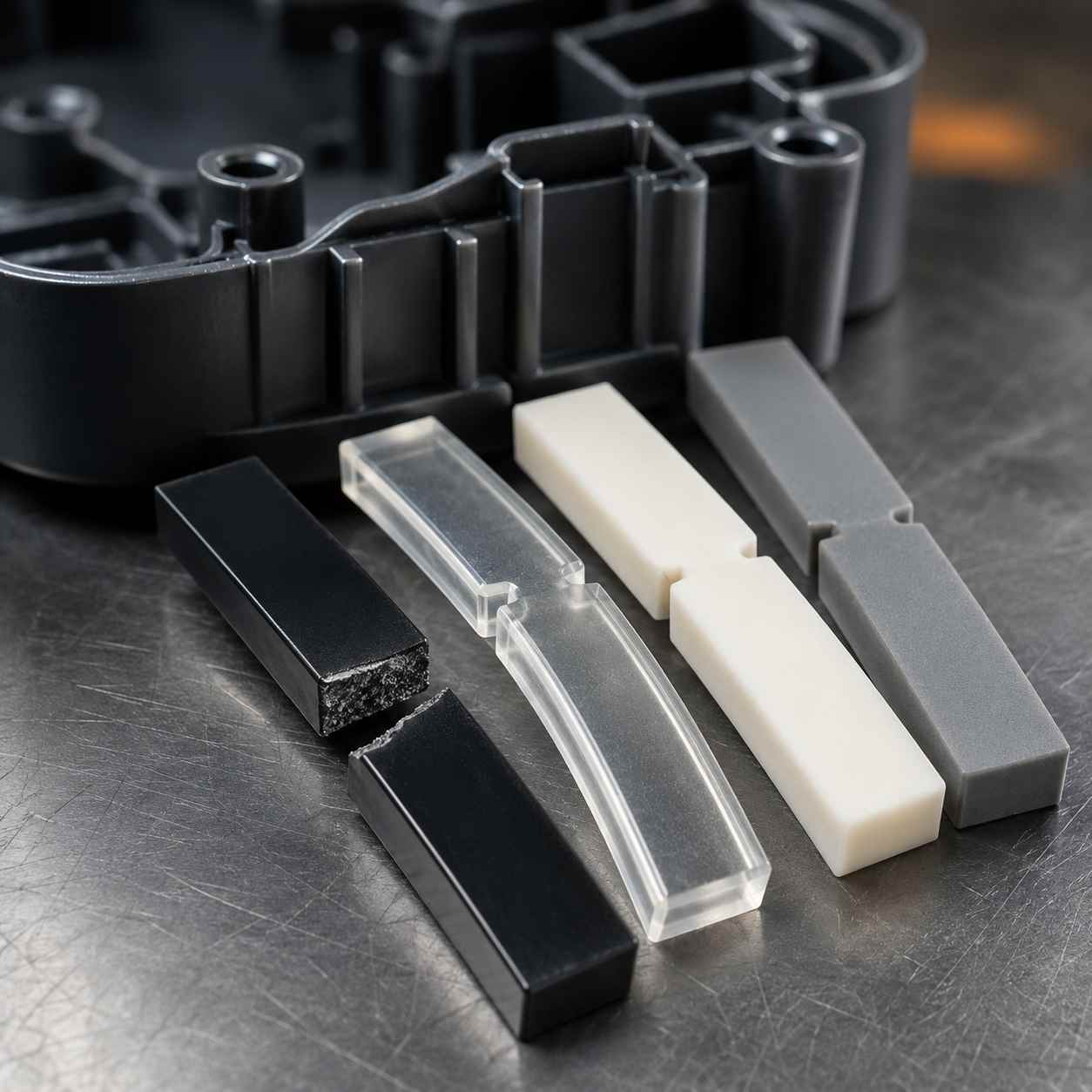
An instrument enclosure falls off a desk and cracks along a rib. A bracket that ran fine for a year breaks in winter frost. An equipment cover carries its static load without trouble but shatters from a single knock with a wrench. In all these cases the cause is the same: the part was designed and molded for "strength" while it actually works under impact. Impact-resistant plastics are a distinct class of materials with their own selection logic, their own traps, and very demanding requirements for molding technology.
In this article we look at what impact strength means in practice, how ABS, polycarbonate, polyamides and the PC/ABS blend differ, how these materials behave at sub-zero temperatures and — most importantly — why a part made from a formally impact-resistant polymer still breaks. Promservice designs and builds molds and runs injection molding on its own fleet of machines, so we look at the subject from both sides at once: material and technology. Here the focus is specifically on impact resistance; the broader guide to selecting a polymer for molding we published earlier.
Impact strength is not the same as strength
Tensile strength shows what load a material withstands under slow pulling. Impact strength shows how much energy a material absorbs while failing within milliseconds. These are different mechanisms, and a high figure in the first does not guarantee the second. A rigid, brittle material fails with no visible deformation; a tough one first "flows," absorbing energy, and only then tears. A polymer can have excellent yield-point numbers and still shatter after a one-meter drop. So if a part gets dropped, takes knocks, is installed with impact tools, or sees vibration with an impact component, the selection criterion must be impact strength, not elastic modulus.
Izod, Charpy and what the datasheet numbers mean
Impact strength is measured by pendulum methods — Izod and Charpy. A specimen is struck by a pendulum and the absorbed energy is calculated relative to the cross-section area or the specimen thickness. The methods differ in how the specimen is held (Izod — cantilevered, Charpy — on two supports), so their numbers cannot be compared directly.
Something else matters far more: tests are run notched and unnotched. Unnotched, many plastics show very high values; notched, the picture changes radically — and that is the one closer to a real part, which always has corners, ribs, holes and ejector pin marks. Materials can only be compared correctly using the same method, specimen thickness and test temperature.
Notch sensitivity: the main trap
Notch sensitivity is how sharply a material's impact strength drops in the presence of a stress concentrator. One polymer loses part of its toughness, another loses most of it, turning from tough into practically brittle.
In a real part, anything can act as a concentrator: a sharp internal corner without a radius, an abrupt wall thickness transition, the edge of a hole, an undercut, a tool mark on a molding surface, an ejector pin mark, even leftover flash. That is why a material with high notch sensitivity demands a more careful design and better mold surface quality. It explains a typical situation: two manufacturers mold the same part from the same material, yet drop resistance differs several times over. The difference is not in the pellet but in the geometry and the technology.
Where impact resistance is critical
Impact loads are not a rare scenario but the normal operating mode for most industrial parts:
- enclosures and covers for instruments, tools and equipment — they get dropped, knocked and transported;
- brackets and mountings — they take jerks, vibration and impact installation;
- protective panels and guards — they absorb accidental blows on the shop floor;
- parts for outdoor equipment — agricultural machinery, municipal and construction equipment, external cabinets;
- automotive components and electrical enclosures — with requirements for cold-temperature behavior.
In all these cases failure usually starts not where the load is highest but where a concentrator is present.
ABS — the universal impact-resistant engineering material
ABS (acrylonitrile butadiene styrene) is the baseline choice when you need a sensible balance of stiffness, impact strength, appearance and price. The rubber phase in the material's structure absorbs impact energy, so ABS is noticeably tougher than "pure" polystyrene at comparable stiffness.
Strengths: good as-molded surface (gloss or texture), stable processing, a wide process window, easy painting, grade availability. Shrinkage is roughly 0.4–0.7%, which gives predictable dimensions. The limitations are equally well known: limited UV resistance (for outdoor parts — stabilized grades or a switch to ASA), poor contact with aromatic solvents, a noticeable drop in impact strength in the cold. The pellet is hygroscopic — drying is mandatory, otherwise silver streaks appear and part strength falls.
PC — maximum impact strength and the main risk
Polycarbonate (PC) is the toughest of the transparent engineering thermoplastics. It retains toughness across a wide temperature range, including sub-zero, so it is used where a part absolutely must not shatter: protective screens, light covers, transparent lids, tool housings, technical "glazing."
But there is a price. First, PC has high notch sensitivity: a sharp corner, an ejector pin mark, a scratch or coarse flash can turn a very tough part into a brittle one. On top of that comes thickness dependence: PC impact strength drops off sharply as the section grows, and a wall of about 3 mm or more behaves markedly more brittle than a thin-walled part in the same grade. Second, it is prone to environmental stress cracking in contact with chemicals — residual stresses plus the wrong cleaning agent, adhesive or lubricant produce a network of cracks with no impact at all.
Third, it is a demanding material to process: high barrel temperature, thorough pellet drying (under-dried PC degrades with a loss of molecular weight and, with it, impact strength), hot molds, good venting. With PC you cannot "bend the process a little": the part will look fine and shatter on the very first drop.
PA — toughness, wear and the moisture question
Polyamides (PA6, PA66, PA12) combine toughness, wear resistance and resistance to oils and fuels, so they are often chosen for loaded assemblies: brackets, bushings, gears, fasteners, under-hood parts.
A key nuance that gets ignored regularly: freshly molded dry polyamide is brittle. The datasheet impact strength of PA6 and PA66 is only reached after conditioning — absorbing equilibrium moisture from the air. A part tested right after molding may perform several times worse than the same part after a few weeks in service. PA12 is far more stable in moisture uptake and gives more predictable behavior.
Glass fiber raises stiffness, strength and dimensional stability but reduces impact strength — the part becomes more brittle, especially at a notch. If the task is specifically about impact, glass-filled PA is often a step in the wrong direction. Pellet drying is mandatory: moisture during processing causes hydrolysis and an irreversible loss of properties.
PC/ABS — the blend with the best practical balance
PC/ABS is a blend of polycarbonate and ABS that takes most of the advantages of both. Impact strength approaches that of PC, but flow is better, notch sensitivity is lower, dimensional stability is higher, processing temperature is lower and cost is below that of pure PC.
That is exactly why PC/ABS became the standard material for electronics and instrument enclosures, automotive components, electrical housings and tool housings. The blend holds up well under impact at reduced temperatures and forgives design choices that PC would not.
The component ratio defines the character: more PC — more toughness and heat resistance; more ABS — better processing, surface and price. Drying before molding is mandatory, just as for pure polycarbonate.
Modified and specialty options
Beyond the "big four," a few more solutions are used for impact applications:
- Impact modifiers. Elastomer additives increase the toughness of the base polymer at the cost of some stiffness and heat resistance. Ready-made modified grades are usually a more reliable route than blending in-house.
- ASA. Essentially ABS in which the butadiene phase is replaced by a UV-stable one. A sensible choice for outdoor parts that must keep their color and not lose toughness in the sun.
- PP with elastomer (copolymers, TPO). An inexpensive solution for moderate requirements: good impact resistance, including in the cold, and chemical resistance, but low stiffness and high shrinkage.
- POM as a counterexample. Rigid, wear-resistant, dimensionally stable, but notch-sensitive and not an impact-resistant material in the usual sense. A common mistake is picking POM "because it's strong" for a part that gets dropped.
Cold-temperature behavior — a criterion of its own
For Ukrainian equipment working outdoors, the ductile-to-brittle transition temperature matters more than the datasheet impact strength at +23 °C. Many polymers that are perfectly tough indoors behave completely differently at minus 20 to minus 30 °C:
- the impact strength of ABS falls noticeably with temperature — for winter outdoor parts this is often the decisive argument against it;
- PC and PC/ABS retain toughness in the cold far better and remain the primary candidates;
- polyamides turn brittle in the cold even when conditioned: the moisture stays in the part, but below the glass transition it no longer acts as a plasticizer;
- PP copolymers with elastomer are specifically developed for low temperatures at a moderate price;
- stress concentrators act more harshly in the cold: what held up in summer cracks in winter.
If a part is used outdoors in winter, testing must be done at the operating temperature, not in the shop.
How to choose: a checklist of questions
Before selecting a grade it helps to answer a few questions in writing — it immediately narrows the field of materials:
- What is the operating temperature? Especially the lower limit, and whether impact actually occurs in the cold.
- What is the nature of the load? A fast impact and drop, or a slow load with deformation.
- Are there concentrators in the geometry? Sharp corners, ribs, holes, undercuts, ejection zones.
- What chemical contact is there? Lubricants, fuel, cleaning agents, adhesives — this is critical for PC.
- Is there UV exposure and outdoor use? If so — ASA, stabilized grades or painting.
- Is transparency required? That effectively narrows the choice to PC.
- What are the requirements for stiffness, weight and cost? Filler adds stiffness but takes away impact strength, and a move to PC or PC/ABS must be justified by the production volume.
The answers should be recorded in the technical specification. The phrase "we need a strong plastic" does not work in production.
Why a part made of "impact-resistant plastic" still breaks
This is the most frequent complaint about molded parts. In the vast majority of cases the cause of failure is not the material but what was done with it:
- A weld line in a loaded area. Where melt fronts meet is the weakest zone of the part. In filled materials the fibers there are oriented crosswise, and local strength drops several times over.
- Sharp internal corners without radii. The classic stress concentrator; for PC it is a nearly guaranteed crack.
- Internal stresses. Injection that is too fast or too slow, excessive holding pressure, uneven cooling — the part comes out "charged" and cracks even without an impact.
- Polymer degradation. Barrel overheating, long melt residence, under-dried pellet — molecular weight drops, and impact strength with it. Externally the part looks fine.
- Excess regrind. Every processing cycle lowers toughness. For critical parts the regrind share must be limited and controlled.
- Ejector pin marks and undercuts. Pushed-in or mirror-polished marks, burrs and flash remnants in a loaded area become the start of a crack.
- A cold mold. Reduced mold temperature gives poorer welding of weld lines, higher stresses and a worse surface.
- Glass fiber across the load. Fiber orientation depends on the gate location; if it does not match the load direction, the calculated strength is never reached.
That is why in impact applications the result is determined not by the material datasheet but by the chain "part design — mold design — molding parameters."
Design recommendations for impact-resistant parts
Most problems are solved back in the 3D model, and that is the cheapest stage:
- Radii on all internal corners. As a guideline, a radius of at least half the wall thickness; any radius is better than a sharp corner.
- Uniform wall thickness. Abrupt changes create both stresses and sink marks; transitions should be made gradual.
- Ribs thinner than the wall. Roughly 0.6–0.7 of the wall thickness for amorphous materials (ABS, PC, PC/ABS) and 0.4–0.6 for semi-crystalline ones (PA, POM, PP): they shrink more, so sink marks appear at the rib base sooner.
- Weld lines outside loaded areas. Their position is controlled by the gate location — this is agreed before the mold is built.
- Gate location with orientation in mind. For filled materials the flow direction should, where possible, match the direction of the working load.
- Ejection zones and markings away from critical areas. Ejector pins, lettering and engraving are moved to places where their marks do not act as concentrators.
Impact on the mold and the molding process
Impact-resistant materials also raise the requirements for the tooling:
- Gate location and injection balance. It determines where the weld line will be and how fibers orient; for multi-cavity molds fill balance is critical.
- Venting. Poorly evacuated air produces burn marks and "unwelded" weld lines — and that is exactly where the part breaks later.
- Mold temperature. PC and PC/ABS need hot molds: this reduces stresses and improves the welding of flow fronts.
- Injection and holding profile. A smooth profile and a correct switchover to holding reduce residual stresses without sink marks.
- Material drying. For PC, PA and PC/ABS this is not a recommendation but a condition for achieving datasheet properties.
- Mold life with filled compounds. Glass fiber is abrasive: hardened steels, replaceable inserts in wear zones and planned tooling service are required.
- Polishing of molding surfaces. Tool marks transfer to the part and act as micro-notches — for PC this matters directly.
How Promservice helps with impact-resistant parts
Promservice runs such projects from design review to series molding:
- we analyze the 3D model and drawings for manufacturability with a focus on stress concentrators — radii, thickness transitions, ribs, ejection zones;
- we help select the polymer for the real service conditions, including sub-zero temperatures, chemicals and UV;
- we design the mold with calculation of the gate location, weld line positions, venting and thermal balance;
- we build the tooling at our own toolroom — CNC milling, EDM, grinding, polishing of molding surfaces;
- we mold styrenic plastics, polycarbonates, polyamides, engineering and filled compounds on a fleet of 22 injection molding machines with clamping force from 50 to 650 tons;
- we dial in the process during trial runs: drying, mold temperature, injection and holding profile — so the part actually gets the properties built into the material;
- we provide repair, upgrading and storage of tooling, in particular when working with abrasive glass-filled grades.
The work is performed within a quality management system compliant with ISO 9001:2015, with our own monitoring of production processes.
Need impact-resistant plastic parts?
If your product works under impact, drops or frost and you are choosing between ABS, polycarbonate, polyamide and PC/ABS — contact Promservice. Send a 3D model, drawing or sample: we'll review the design for hidden stress concentrators, recommend impact-resistant plastics for your service conditions, and provide mold design and series molding with consistent quality.