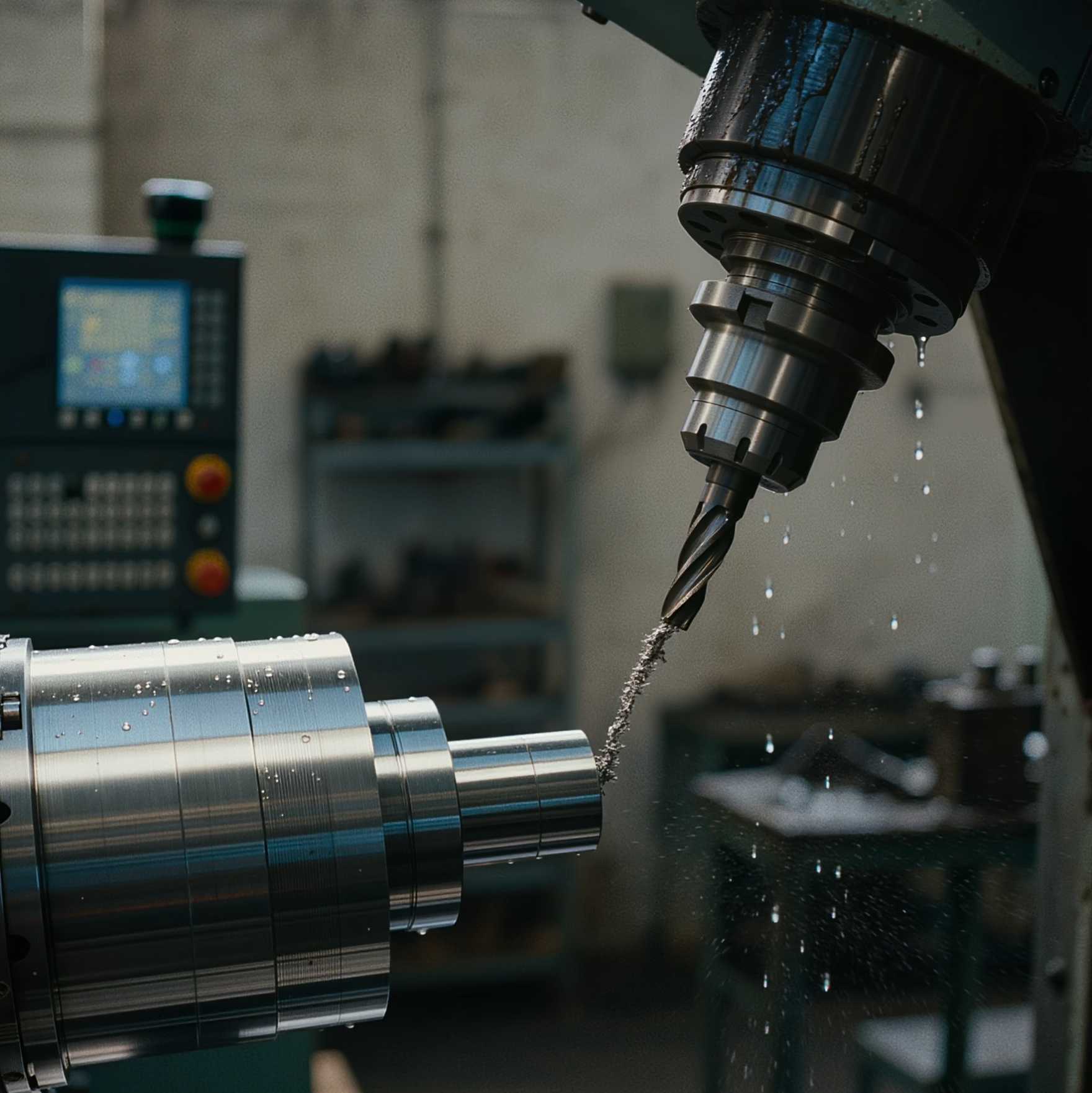
Many industrial companies routinely need precision metal parts: shafts, bushings, flanges, housings, brackets, adapters, custom fasteners. Running an in-house CNC operation just for this is costly and often overkill. Contract CNC turning and milling gives the customer the same quality as an in-house shop without capital investment in machines, staff, and tooling.
Promservice provides contract machining services in Ukraine: turning and milling on CNC machines, from single parts and prototypes to serial production. With an in-house toolroom, we produce both parts for external projects and components for our own tooling — which means we understand exactly what tight tolerances, fits, and repeatability require.
What contract CNC machining includes
Contract CNC machining is the manufacturing of parts to the customer's specification on the contractor's equipment. The service typically covers:
- drawing review and manufacturability assessment;
- material selection (bar stock, forging, plate);
- CAM programming for the machine;
- the actual machining (turning, milling, mill-turn);
- dimensional and surface inspection;
- if needed — heat treatment, grinding, coatings via partners;
- marking, packaging, and delivery to the customer.
For the customer this means receiving a finished part to drawing — not raw material plus a list of operations that still need to happen somewhere.
What parts are typically ordered for CNC machining
The product range is wide and often industry-driven:
- rotational parts — shafts, axles, rods, bushings, flanges, fittings, adapters, lead screws;
- prismatic housings — gear housings, holders, brackets, plates, mounting bases;
- tooling components — punches, dies, inserts, plates, bushings for molds and dies;
- gear and threaded features — custom nuts, pulleys, flanged joints;
- spare parts — for industrial equipment, conveyors, machinery;
- custom parts — to individual drawings, for upgrades or repairs of equipment.
CNC works equally well for one-off replacement parts and for serial runs of standard components.
CNC turning: when it fits
Turning is used for parts with predominantly axial symmetry — where the main surfaces are formed by rotating the workpiece around an axis.
Typical turning operations on CNC lathes:
- external and internal cylindrical surfaces;
- faces, chamfers, grooves;
- internal bores for bearings;
- threads (external and internal);
- complex rotational geometry with multiple diameters;
- precision mating surfaces.
Modern turning centers are often equipped with live tooling — this allows milling of slots, off-axis drilling, and spline cutting in a single setup. The result: fewer operations and better positional accuracy between features.
CNC milling: when it is essential
Milling is the universal machining method for prismatic and complex-profile parts.
Typical milling operations on CNC machining centers:
- planes, bosses, slots, pockets;
- drilling, counterboring, thread tapping;
- complex 3D surfaces (molds, dies, housings);
- jig-bore work with precise hole-to-hole distances;
- machining of pre-formed blanks in various shapes;
- finishing of mating surfaces after heat treatment (if needed).
For complex parts, 4- and 5-axis machining is used to reach surfaces from different sides in one setup — this reduces refixturing and improves the accuracy of feature-to-feature positions.
Materials Promservice machines
Depending on part requirements, CNC machining is done in different materials:
- structural steels — for a wide range of technical parts;
- stainless steel — for corrosion-resistant, food-grade, and medical applications;
- tool steels — for tooling components, dies, molds (often after heat treatment);
- aluminum alloys — for lightweight housings, prototypes, serial components;
- brass and bronze — for parts with wear, sliding, or electrical conductivity requirements;
- specialty alloys — to customer specification.
For each material, the right tooling, cutting parameters, and operation sequence are selected.
Accuracy and tolerances: what to watch
Tolerances on CNC parts are not "always the same" — they are a parameter that drives cost and complexity. A simple approach helps assess needs realistically:
- general tolerances (for non-functional surfaces) — loose, cheap to machine;
- fits (bearings, bushings, shaft holes) — tighter, selected per H7/h6 and similar standards;
- critical dimensions (for assembly fits) — called out explicitly, verified with instruments;
- geometric tolerances (flatness, parallelism, concentricity) — critical to part function.
The tighter the tolerance, the more operations, additional inspection, grinding, or finishing are needed. It pays to specify the actual precision required, not the "maximum just in case."
Quality control of parts
Batch stability in contract CNC machining is ensured through structured control:
- incoming inspection of stock (grade, hardness, dimensions);
- tooling and program parameter verification;
- first-article inspection of the first parts in a batch;
- periodic measurement of critical dimensions during the run;
- final inspection before shipment;
- measurement reports for the customer when required.
For critical parts, measurements are performed on coordinate measuring machines (CMM) or with other instruments at the required accuracy.
Single parts, prototypes, and serial runs
Contract CNC machining scales across different tasks:
- Single parts and spares. Made for equipment repair or modernization, often from samples or sketches. Fast turnaround, minimal setup.
- Prototypes and small batches. For new products — when speed and flexibility matter and the series is still ahead. CNC is far more flexible here than casting or stamping.
- Serial orders. Stable production of standard components on an agreed schedule. Programs, operation sequences, and fixtures are optimized for the run.
- Assembly kits. Several parts that form an assembly — with guaranteed mating fit and repeatability.
Promservice handles all order types — from a single piece to recurring serial deliveries.
What is needed to quote and start work
To get a quick and realistic quote and timeline, the following information helps:
- drawings (PDF) or 3D models (STEP, IGES);
- material grade or requirements;
- required quantity;
- requirements for heat treatment, coatings, marking (if any);
- target lead time;
- special requirements (inspection, reports, packaging).
The more complete the package, the faster Promservice can return a realistic offer without back-and-forth.
Why Promservice: toolroom plus CNC
CNC machining works best when an engineering team and adjacent technologies are available next door. Promservice combines:
- a CNC machine fleet (turning and milling centers);
- a toolroom with experience in molds and dies;
- EDM for complex and hardened parts;
- grinding and finishing of mating surfaces;
- a connection to plastic injection molding — when the part is part of a hybrid project (metal + plastic).
This allows us to handle both simple parts and complex jobs where several technologies must come together in one cycle.
Need contract CNC machining in Ukraine?
Promservice provides CNC turning and milling on demand: from single parts and prototypes to serial deliveries. Send drawings or 3D models — we will evaluate manufacturability, return a commercial offer, and deliver stable production at the required accuracy.